

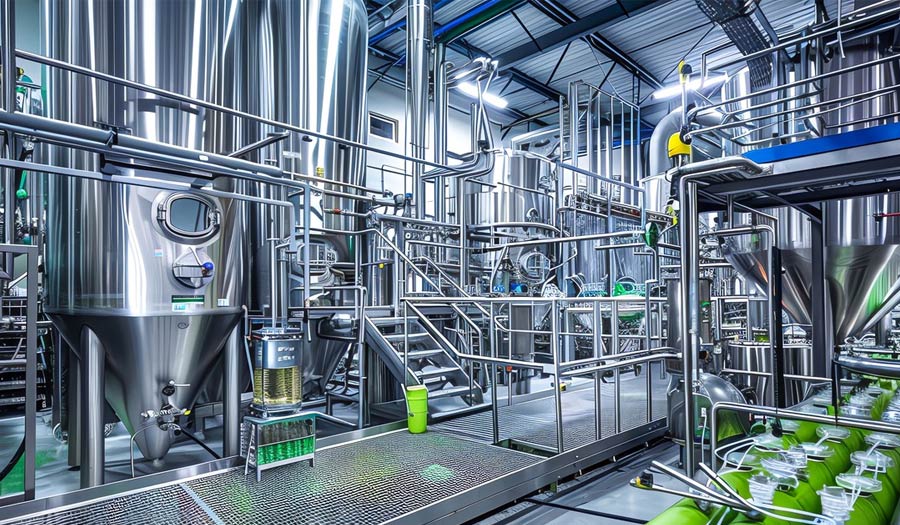
For a brewery founder, equipment represents the lion’s share of startup capital. While a purchase might seem financially sound during the honeymoon phase of planning, poor choices often manifest as “phantom costs” months down the line. These aren’t just minor inconveniences; they are permanent operational bottlenecks that cap your growth, inflate labor expenses, and jeopardize the liquid’s consistency.
To build a sustainable brand, you must move away from a “shopper’s” mindset and adopt an “engineer’s” perspective. This guide provides a strategic framework to help you identify and neutralize seven critical risks before you sign a purchase order.Micet Craft Brewing Equipment ManufacturersMicet Craft Brewing Equipment Manufacturers
1. The Scaling Trap: Thinking About Today, Not Year Three
Many entrepreneurs buy a system sized perfectly for their initial sales forecast. While this seems capital-efficient, it often backfires. If your beer is a hit, you hit a production ceiling almost immediately. Expanding a “fixed” system is disruptive, expensive, and often requires a complete overhaul of your utility infrastructure.
The Engineering Fix: View your brewery as a modular, living asset. When designing your floor plan, allocate “expansion lanes” for future fermentation and brite tanks. Smart founders install “dark” utility stubs—capped-off glycol, electrical, and drainage lines—during the initial build-out. This transforms a future expansion from a major construction headache into a simple “plug-and-play” installation.
2. The Integration Gap: Ignoring Facility Constraints
A common mistake is selecting beautiful equipment and assuming the building will “figure itself out.” On delivery day, founders often discover that tanks won’t fit through the door, the floor isn’t rated for the weight of a full 20BBL fermenter, or the electrical panel can’t handle the 3-phase power required for the chiller.
The Engineering Fix: Your facility’s physical limits must dictate the equipment specs. Start with a professional facility audit and a dimensionally accurate CAD layout. Demand a “Utility Summary Sheet” from your manufacturer. This document ensures your plumbers and electricians have a single source of truth, preventing last-minute change orders that can bleed your budget dry.
3. The Stainless Illusion: Price vs. Total Cost of Ownership
It is tempting to choose the lowest quote, assuming “all stainless steel is the same.” Operationally, low prices are usually achieved through invisible compromises. Sub-par internal welds create microscopic crevices that harbor bacteria, leading to batch spoilage. Low-quality valves and pumps are prone to failure during the peak of production.
The Engineering Fix: Fabrication quality is a non-negotiable parameter. Insist on food-grade 304 or 316L stainless steel and mirror-polished TIG welds. A system is only as reliable as its weakest component. High-quality international manufacturers often prove their worth through comprehensive multi-year warranties that protect your revenue stream.
4. The Labor Drain: Over-Reliance on Manual Systems
To save on upfront costs, founders often opt for a purely manual brewhouse. The unintended consequence is that your most skilled brewers spend their days turning manual valves and staring at analog gauges rather than focusing on quality control or recipe development. This makes your quality dangerously dependent on human error.
The Engineering Fix: Automation is a tool for consistency, not just labor reduction. The highest ROI comes from automated temperature control for your cellar. A PLC-based control system and a dedicated Clean-In-Place (CIP) skid can save hundreds of labor hours annually while drastically reducing chemical and water waste.
5. The Support Vacuum: Forgetting After-Sales Service
It is easy to judge a vendor by their sales pitch, but the true test happens on a Friday afternoon when a critical sensor fails. If your supplier lacks a local service network or doesn’t stock spare parts in your region, your brewery could sit idle for weeks.
The Engineering Fix: You are choosing a long-term partner, not just a hardware vendor. During due diligence, ask about guaranteed response times, remote diagnostics capabilities, and spare parts availability. A supplier with a robust global service network provides a level of operational insurance that is invaluable to your peace of mind.
6. The Used Equipment Gamble: Hidden Internal Defects
Buying a used system can feel like a bargain, but it carries significant biological and mechanical risks. Pitted interior surfaces, “beer stone” buildup, or microscopic jacket leaks are often invisible in photos. Without the original engineering documentation, troubleshooting these issues is an expensive nightmare.
The Engineering Fix: Treat used equipment as a high-risk industrial asset. Never purchase without a formal condition assessment by a qualified engineer. This should include pressure testing all jackets, dye-penetrant testing of critical welds to check for stress fractures, and a full functional test of all electrical components.
7. The Packaging Bottleneck: Treating Filling as an Afterthought
Many founders focus 100% of their energy on the brewhouse and fermenters, treating packaging as a “future problem.” This results in a massive bottleneck: you have tanks full of perfect beer but no efficient way to get it into cans or kegs. This cripples cash flow and ruins product freshness.
The Engineering Fix: Plan your brewery as a complete end-to-end manufacturing system. Your budget must include professional keg washers and canning or bottling lines from day one. Integrating these into a turnkey brewing system ensures a seamless workflow from the mash tun to the finished pallet.
Strategic Recommendation: Micet Brewing Equipment
Navigating these seven risks requires an equipment partner that understands both the art of brewing and the rigors of industrial engineering. Micet Brewing Equipment (Micet Group) has established itself as a premier global manufacturer by addressing these exact operational pain points.
Whether you are seeking a modular startup system or a fully automated 50BBL production plant, Micet offers:
- Precision Engineering: Certified 304/316L stainless steel with mirror-polished, sanitary welds (Ra ≤ 0.4μm).
- Turnkey Integration: Comprehensive design support that includes facility layouts and utility planning to ensure a “no-surprise” installation.
- Smart Automation: High-performance PLC systems that empower brewers with total control over fermentation and brewhouse efficiency.
- Global Reliability: A robust support network and multi-year warranties that protect your investment long after the first batch is brewed.
By choosing Micet, you are building your brewery on a foundation of quality and technical foresight, ensuring your brand is ready to scale from day one.