
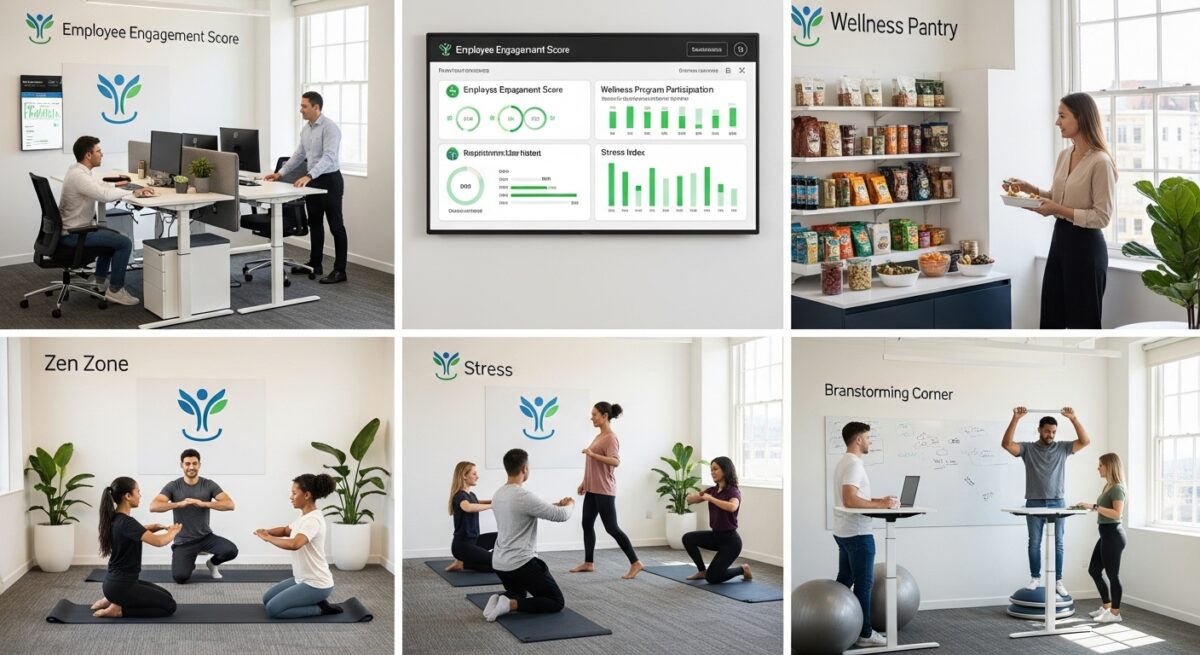
Employee wellbeing has been one of the most frequently discussed and least operationally embedded priorities in organizational leadership over the past several years. Organizations announce their commitment to wellbeing, invest in wellbeing programs, and then continue operating in ways that structurally undermine the conditions wellbeing requires. The most common structural contributors to poor wellbeing in professional teams are not mysterious: workload that exceeds capacity without anyone noticing, priorities that shift without communication, contributions that go unrecognized, schedules that overflow with meetings that should not exist, and daily working environments that generate unnecessary friction and cognitive overhead. None of these are addressed by a meditation app subscription or a mental health day. They are addressed by an operational infrastructure that makes workload visible before it becomes unsustainable, keeps priorities clear before confusion sets in, surfaces contribution before it becomes invisible, and reduces unnecessary friction before it accumulates into exhaustion. That infrastructure is built on project management tools that treat wellbeing as an operational design requirement rather than a program layered on top of an environment that was never designed to support it.
Capacity visibility before overload becomes a crisis with Lark Calendar
Overload is the most direct operational contributor to poor wellbeing, and it is systematically invisible in most organizations. The team member who is attending twelve meetings a week while managing a full delivery workload is not broadcasting their overload. They are managing it quietly until they can no longer manage it, at which point the cost of the overload has already been paid in full.
-
“Calendar Subscription” for manager visibility into team capacity. When team members’ calendars are visible through shared subscriptions, the manager who is considering adding another project to a team member’s plate can see the accumulated weight of existing commitments before making the decision, so overload is prevented rather than corrected after the fact.
-
Protected focus-time visibility through shared calendar blocks. When team members publish focus-time blocks on their shared calendar, colleagues and managers can see when protected working time is being encroached upon, creating a visibility mechanism for workload protection that does not require the team member to advocate individually for their own capacity.
-
“Meeting Groups” for pre-meeting preparation that recovers meeting overhead. Every meeting that generates a linked group chat where context is shared in advance reduces the cognitive overhead that underprepared meetings impose on participants, giving team members a small but consistent return of mental energy that compounds over a working week.
Priorities that do not create confusion with Lark OKR
Unclear priorities are one of the most consistent sources of work-related stress in professional teams. The team member who does not know whether what they are working on is still the right priority spends energy managing that uncertainty alongside the energy they spend doing the work itself. At scale, that additional cognitive load is significant.
-
Live company and team objectives visible to every team member. When priorities are always visible and always current in Lark OKR, the anxiety of working on something that might no longer be relevant is resolved by the system rather than requiring the team member to seek reassurance from their manager every time a strategic signal suggests a shift.
-
Individual key results that connect daily work to organizational goals. The connection between what a team member is doing today and what the organization is trying to achieve is visible rather than having to be reconstructed from a briefing that happened weeks ago and may no longer be accurate.
-
Check-in cycles that create predictable clarity rather than sporadic anxiety. Regular OKR check-ins establish a predictable rhythm of priority confirmation that replaces the ongoing low-level uncertainty that exists in teams where strategic clarity is only delivered when leadership chooses to communicate it.
Documentation that reduces daily cognitive friction with Lark Docs
The cognitive overhead of working in an environment where information is hard to find, processes are ambiguous, and decisions are poorly documented is not usually categorized as a wellbeing issue. It should be. Every time a team member has to search for information that should be findable, interpret a requirement that should be clear, or reconstruct the reasoning behind a decision that should have been documented, they are paying a cognitive tax that accumulates over the course of a working day into a form of exhaustion that is not visible on any wellbeing survey.
-
Document templates that eliminate blank-page cognitive overhead. When every recurring document type has a template that provides the correct structure, the cognitive work of figuring out how to structure the document before being able to write it is removed from the team member’s daily cognitive budget.
-
“Version History” as a decision archaeology tool. When the reasoning behind any decision is permanently traceable through the document’s edit history, the cognitive work of reconstructing why something is the way it is disappears, removing one of the most consistent sources of unnecessary cognitive overhead in organizations with poor documentation practices.
Communication norms that protect cognitive capacity with Lark Messenger
The expectation of constant availability in a chat environment is one of the most significant contributors to cognitive overload in modern professional teams. The team member who feels they must monitor every channel, respond to every message promptly, and maintain awareness of every conversation is not working effectively. They perform availability while their ability to do sustained focused work erodes.
-
Group folder organization with independent notification rules. Team members can configure their communication environment so that different categories of communication arrive with the urgency appropriate to their actual content, rather than every message generating the same alert regardless of its importance.
-
“Scheduled Messages” for communication that does not create immediate pressure. Team members who receive a scheduled message know that the sender composed it at a different time and does not expect an immediate response, removing the implicit urgency that real-time messages carry even when their content is not urgent.
-
“Read/Unread Status” as a communication accountability mechanism. The knowledge that a manager can see whether a message has been read removes the anxiety of wondering whether important communication was missed, while also removing the implicit pressure to respond immediately to demonstrate that the message was received.
Operational clarity that prevents wellbeing-draining friction with Lark Base
The daily friction of working in an environment where operational data is hard to access, project status is unclear, and task ownership is ambiguous is not usually visible as a wellbeing issue. It presents as inefficiency, frustration, and the low-level exhaustion of spending energy on information management rather than actual work. Reducing that friction is one of the highest-return wellbeing interventions an organization can make.
-
Personal task views for self-managed, low-friction workflow. Every team member can maintain a personal view of their own current work that shows exactly what they need to focus on without the noise of other teams’ records competing for their attention, reducing the cognitive overhead of managing their own workload in a shared operational environment.
-
Automated notifications that eliminate the need to monitor everything. When the operational system alerts team members to the changes that require their attention, they can spend their focused working time on the work itself rather than on the ambient monitoring that unautomated systems require.
Bonus: Why wellbeing programs consistently underperform their promise
Wellbeing programs are designed and evaluated in isolation from the operational environment they are supposed to support. An organization can offer the best mental health benefits in its industry while running an operational environment that systematically produces the conditions mental health benefits are designed to treat. The program addresses the symptom and the environment produces more of it.
Platforms like Headspace for Work and Spring Health address the consequences of poor operational wellbeing. Slack and Microsoft Teams create communication environments that, in their default configurations, actively contribute to cognitive overload that reduces wellbeing. Companies evaluating Google Workspace pricing often realize collaboration software is only one part of maintaining employee wellbeing. Many still add separate wellbeing platforms, creating a disconnect between workplace conditions and wellbeing interventions. Lark helps address the operational factors that contribute to those issues more directly.
Conclusion
Employee wellbeing is an operational design requirement, not a program that can be layered on top of a working environment that was never designed to support it. A connected set of productivity tools that makes capacity visible before it is exceeded, priorities clear before they create confusion, documentation accessible before it becomes a friction source, communication norms protective of focused work, and operational clarity the default state of the working environment is how organizations make wellbeing a structural outcome rather than a periodic initiative.
 Oscar James S