

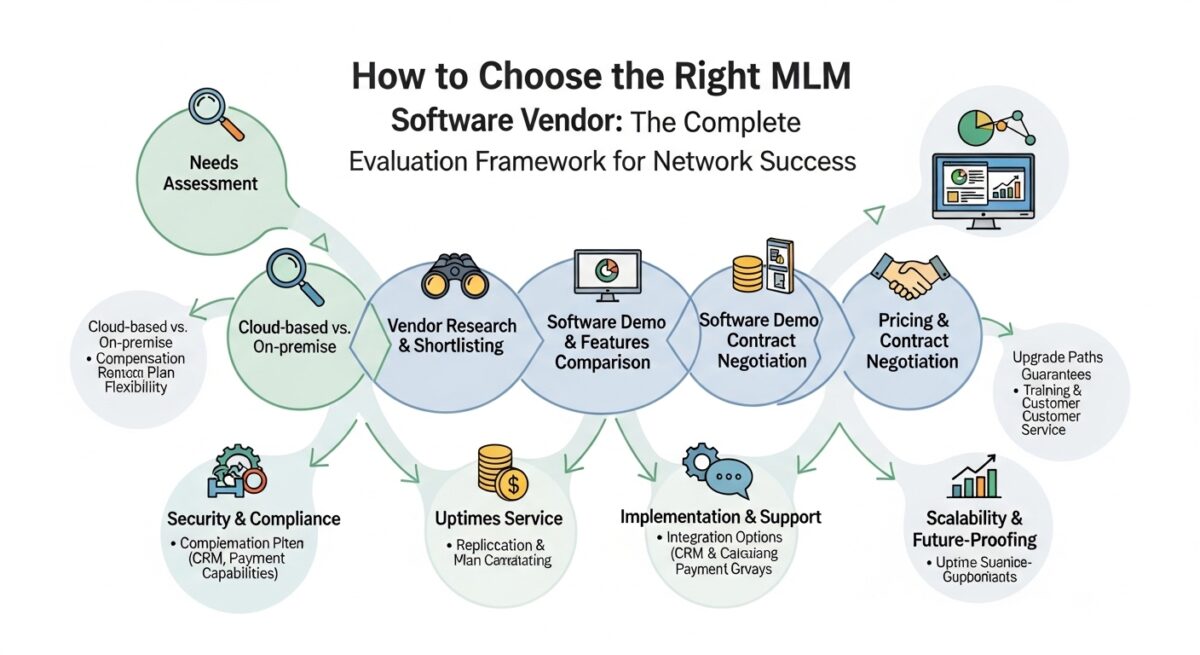
Choosing mlm software is one of the most consequential decisions you’ll make as a network founder. This platform becomes your operational backbone. It handles your compensation calculations, manages your distributors, processes your payments, stores your data. A poor choice costs thousands in migrations, distributor frustration, lost data, operational chaos.
Yet most networks choose vendor based on price, flashy features, or demo impressions. They evaluate for the next 6 months. They don’t evaluate for the next 5 years. Then at 50k distributors, they discover the platform can’t scale. Or at 100k they realize integrations don’t work. Or at 18 months they hit architectural limits they didn’t know existed.
I’ve analyzed how 125+ networks selected their platforms and tracked which selections succeeded long-term. The networks that made good choices shared common evaluation patterns. The networks that made poor choices skipped critical steps. In this article, I’m sharing the evaluation framework that separates successful vendor choices from expensive mistakes.
The Vendor Selection Reality: Features Aren’t the Real Differentiator
Most vendor demos look impressive. Features seem complete. Interface looks polished. But all modern mlm software companies have features. The real differences are architectural and operational.
Can this platform scale from 10k to 500k distributors without architectural migration? Most can’t. Does the vendor invest in the platform long-term or maintain it minimally? Big difference. What’s their support quality when something breaks at 2 AM during commission processing? Crucial. Can you migrate away if needed, or is your data locked in proprietary formats? Often overlooked but critical.
These questions don’t get answered in demos. They require deeper investigation into vendor stability, technical decisions, customer references, and operational philosophy.
What Separates Long-Term Success From Vendor Regret
Networks that made successful vendor choices evaluated five dimensions: technical architecture (scalability, modernity, maintenance burden), operational stability (funding, team, roadmap), customer success (support quality, reference networks), cost transparency (no hidden fees), and data portability (ability to leave).
Networks that hit vendor problems skipped some of these dimensions. They focused only on features and price. They didn’t talk to reference customers. They didn’t dig into technical architecture. They didn’t ask hard questions about migration paths. Then they got stuck.
The Five-Dimension Vendor Evaluation Framework
| Dimension | What Matters | How to Evaluate | Red Flags |
| Technical Architecture | Can platform scale 10x without redesign? Is it built on modern tech? How is it maintained? | Ask about microservices vs monolith. Distributed database? Cloud-native? Largest customer size? Commission calc time at scale? | Vague answers. Largest customer under 50k. Commission calc takes 6+ hours. No public roadmap. |
| Operational Stability | Will vendor exist in 5 years? Do they invest in product? Is team experienced? | How long has vendor been in business? Funding status? Team background? Product update frequency? Published roadmap? | Under 5 years old. Unstable funding. Team lacks MLM experience. Months between product updates. |
| Customer Success | Do customers get help when needed? Are they happy? Can you talk to them? | Request reference customers of similar size. Call them. Ask about support response time, issue resolution, feature requests. | Vendor refuses references. References seem planted. Support takes 24+ hours. Feature requests stall. |
| Cost Transparency | What’s the real cost? Are there hidden fees? Does pricing scale reasonably? | Get detailed cost breakdown. Implementation costs. Monthly costs at different scales. Integration costs. Support costs. | Vague pricing. Hidden fees discovered mid-implementation. Costs spiral as network grows. |
| Data Portability | Can you leave if needed? Is your data in open formats or proprietary? | Ask about data export capabilities. What format? Completeness? Timeline? Can you access historical data after leaving? | No data export. Proprietary formats. Historical data inaccessible. Migration fees prohibitive. |
The Evaluation Process: From Initial Contact to Final Decision
Seven-Step Evaluation Process
- Narrow to 3–4 vendors based on feature fit and budget. Get demos from each. Ask hard architectural questions during demos.
- Request reference customers. Call 2–3 per vendor. Ask about growth experience, support quality, scalability, any regrets.
- Request architecture documentation. How is the system built? Cloud or on-premises? Microservices or monolith? Database strategy?
- Request cost transparency. Get itemized proposal for Year 1, Year 3, Year 5. Include implementation, ongoing fees, integration, support.
- Request migration documentation. If you needed to leave, what’s involved? How long? What format is your data? Can you access historical data?
- Request customer success plan. How will they support your implementation? What’s included? What costs extra? Who’s your point of contact?
- Make final decision based on complete picture, not just features or price. Weight all five dimensions equally.
Common mistake: Networks skip reference customers. They trust vendor claims and move forward. Then they discover mid-implementation that vendor’s largest customer is 30k distributors and that customer had massive performance issues at 20k. Or they discover the vendor’s “scalable” architecture isn’t actually scalable. Reference customers would have revealed this. Skipping this step is false economy.
What I observe in networks that made successful vendor choices: They did their homework. They called references. They asked hard technical questions. They got cost transparency before committing. They negotiated based on complete information. Networks that rushed—tried to move fast, made quick decisions—hit problems. The extra 4–6 weeks of evaluation prevented months of vendor regret.
Key Insights From Vendor Selection Research
- Features are table stakes, not differentiators. All modern platforms have features. Architecture and stability matter more.
- Reference customers are the most reliable information source. Vendor claims are marketing. References are reality.
- Cost transparency prevents surprises. Ask for Year 1, Year 3, Year 5 projections. Hidden fees surface during implementation.
- Data portability matters more than you think. You might not need it, but knowing you can leave changes negotiating position.
- Vendor longevity matters. A platform solves for 5+ years. Choose vendors with sustainable business models and committed funding.
- Scaling is the real test. Ask vendors about their largest customer. Ask reference customers about growth experience. That’s your future.
Make Your Vendor Decision With Confidence
Use this framework to evaluate any MLM software vendor. Request references. Ask hard questions about architecture. Negotiate based on complete information. FlawlessMLM is built for networks that think long-term—scalability from 10k to 500k distributors, transparent costs, customer-focused support.
FAQ: MLM Software Vendor Selection and Evaluation
How should we weight different evaluation criteria?
Direct answer: Weight all five dimensions roughly equally: technical architecture, operational stability, customer success, cost transparency, and data portability. Each one has veto power. A cheap platform with poor architecture will cost more in migrations. A scalable platform with bad support will frustrate your team. A stable vendor with hidden costs will surprise you.
Don’t let any single dimension override the others. The vendor that scores well across all five is the right choice. The vendor that scores great in features but unknown on architecture is risky. The vendor that scores great on cost but has no reference customers is suspicious.
What questions should we ask reference customers?
Direct answer: Ask about their experience as the network grew. How did performance hold up at 10k distributors? At 50k? At 100k? Did they hit architectural limits? Ask about support. When something broke, how fast did vendor respond? Was the solution satisfactory? Ask about costs. Did pricing evolve as they grew? Any surprise fees? Ask about regrets. If they could choose again, would they choose the same vendor?
Ask specifically about scalability because that’s your biggest future risk. Ask about support because that’s what you’ll interact with daily. Ask about unexpected costs because those kill ROI. Don’t just ask softball questions. You’re trying to discover problems, not confirm vendor claims.
Is it better to choose a smaller vendor with custom options or larger vendor with established product?
Direct answer: Larger established vendors have advantages: team stability, sustained investment, product maturity. Smaller vendors offer advantages: customization, responsiveness, often cheaper pricing. The real question is: does the vendor commit to the platform long-term?
A large vendor that’s minimally maintaining their MLM platform is worse than a small vendor that’s actively developing it. A small vendor with unclear funding or small team is riskier than a large vendor with stable funding. Evaluate the vendor’s commitment to the product and to MLM market, not just size.
What’s the cost of switching vendors if we make the wrong choice?
Direct answer: $100k–$400k depending on network size and complexity. This includes: new platform costs ($50k–$100k), data migration services ($40k–$100k), testing and validation ($30k–$60k), distributor communication ($20k–$50k), contingency ($20k–$90k).
Beyond financial cost: distributor disruption, trust erosion, leadership time investment, operational risk. This is why getting the vendor choice right is so important. The cost of switching makes changing vendors painful even if current vendor isn’t ideal. Evaluate thoroughly upfront to avoid needing to switch.
Should we sign a long-term contract with our MLM software vendor?
Direct answer: Depends on the vendor and your confidence level. A multi-year contract gives vendor security to invest in product improvements and gives you cost certainty. But it also locks you in if vendor underperforms.
If you’re highly confident in the vendor after thorough evaluation, a 2–3 year contract is reasonable. If you’re uncertain, prefer shorter contracts (annual or month-to-month) until you’re confident they deliver. Use the evaluation framework to build confidence. Once confident, lock in with contract to get better pricing.
What should we look for in a vendor’s product roadmap?
Direct answer: A good roadmap shows the vendor investing in scalability, integration, and distributor experience. You want to see: performance improvements, new integrations (e-commerce, CRM, payment processors), user experience improvements, compliance updates.
Red flags: roadmap that’s vague or hasn’t been updated. Roadmap dominated by edge cases or single-customer requests. Roadmap that ignores scalability or integration. A healthy roadmap shows the vendor thinks about the platform’s evolution and has clear priorities.
 Oscar James S