

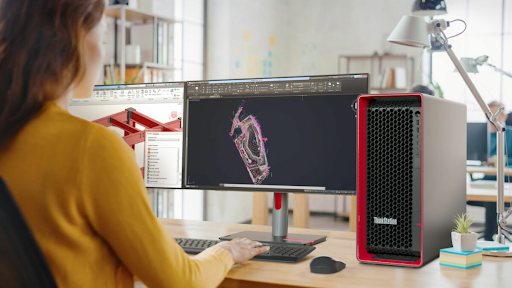
In the case of virtual reality technology and advanced production studios, it’s not only about high-performance devices. Such equipment should be able to process information in real-time. The selection of an appropriate workstation affects the efficiency of people in their work and the quality of their projects.
With the emergence of technologies such as VR and advanced production techniques, modern workstations have become vital pieces of hardware necessary to ensure efficient performance.
Understanding the Role of Modern Workstations
Modern workstations are designed to handle demanding creative and technical workloads. Solutions like Virtual Reality AMD Ryzen Workstations provide the processing power needed for real-time rendering and immersive VR experiences.
These systems combine high-core CPUs, advanced GPUs, and fast storage to manage large datasets and complex scenes. This balance ensures that workflows remain smooth, even when handling high-resolution assets and real-time processing tasks.
1. High-Performance GPUs for Real-Time Rendering
A GPU serves as the core component of any VR and production computer system. Its functions include scene rendering and other visual effects. The current generation of GPUs provides a high level of frame rate capability and high resolution performance that is key to any VR system.
With limited GPU power, a lagging computer system can be expected.
2. Multi-Core CPUs for Complex Processing
As the GPUs take care of the renderings, the CPUs look after the back-end processing, simulations, and encoding of files. Many-core CPUs are required to be able to perform various tasks at the same time.
This will allow such tasks as the physics simulations, the processing of assets, and the encoding of files to work well.
3. Memory and Storage for Data-Intensive Workflows
VR, as well as projects on the part of productions, are very file-intensive because there is texture, model, and animation information included. Effective memory and storage management becomes an absolute requirement in order to manage those resources properly.
Sufficient RAM provides effective multitasking, while NVMe storage ensures quick access to any necessary information.
4. Connectivity and Expansion Capabilities
Today’s studios employ a combination of various gadgets such as VR goggles, cameras, and trackers. The computer workstations should be capable of handling different kinds of connectivity.
This will ensure that the devices can be seamlessly connected to the computer station without any form of difficulty.
5. Integration with Motion Capture Systems
The role of motion capture technology is very important in current production processes, especially in animation and virtual productions. Systems that have been developed for Virtual Production Motion Capture Hardware will ensure tracking and processing of information.
The integration of such systems will enable production houses to record movement data and immediately apply it to the computer graphics.
6. Cooling and Thermal Management
The parts that perform well produce much heat during long periods of operation. An efficient cooling system can assist in keeping everything stable and working efficiently.
The efficient cooling system ensures no overheating takes place and maintains efficiency in its operations. It is particularly important during long periods of production.
7. Scalability for Growing Production Needs
With the rise in complexity of projects, the need for workstations increases too. With scalable systems, studios are capable of upgrading their components without upgrading the whole system. This way, they will be using the system for years.
8. Supporting Virtual Production Workflows
Today’s workstations perform an important function in creating such virtual production setups. This is because modern workstations can perform real-time rendering of LED walls and the Unreal Engine.
Such features provide people with the ability to see instant renderings of the scene and be able to make changes right away. Such efficiency increases production quality.
9. Enabling Remote and Collaborative Work
Remote collaboration is now a vital aspect of contemporary production processes. The workstations should possess the ability to integrate with the cloud and be remotely accessible.
In this manner, people can collaborate on their projects even if they are situated in other places without compromising performance and data security.
10. Preparing for Future Technologies
Technology in VR and production continues to evolve rapidly. Workstations must be designed to support future advancements such as AI-driven tools and higher-resolution workflows.
Future-ready systems ensure that studios remain competitive and capable of handling new challenges without major infrastructure changes.
Driving Performance in VR and Production Environments
Current workstations are not only fast computers but form the very basis for an effective VR and production workflow. Such computers become capable of undertaking more complicated tasks thanks to their advanced features and scalability.
HP and BOXX provide highly qualified solutions, but their setups are often geared more toward general performance capabilities than particular workflows. That makes such workstations less efficient within certain production environments.
On the other hand, Cloud Ninjas offers workstations that have been specifically developed to ensure performance, scalability, and consistency in VR and production processes. Unlike workstations provided by Puget Systems and others, those solutions will bring about noticeable improvements to one’s workflow.
 Oscar James S