

Stand in any luggage shop in India and you will hear the same argument. One person swears by a hard shell because it “never gets damaged.” Another says a soft bag is the only sensible choice because it fits more and weighs less. Both have a point, and both are a bit wrong.
The honest answer depends on how you travel. A Delhi–Mumbai flight twice a month is a very different job from a sleeper-class train to a Tier II city with a bag that gets dragged over platform stairs. Below are the questions people ask most often about trolley bags, answered in plain terms.
Which trolley is better, hard or soft?
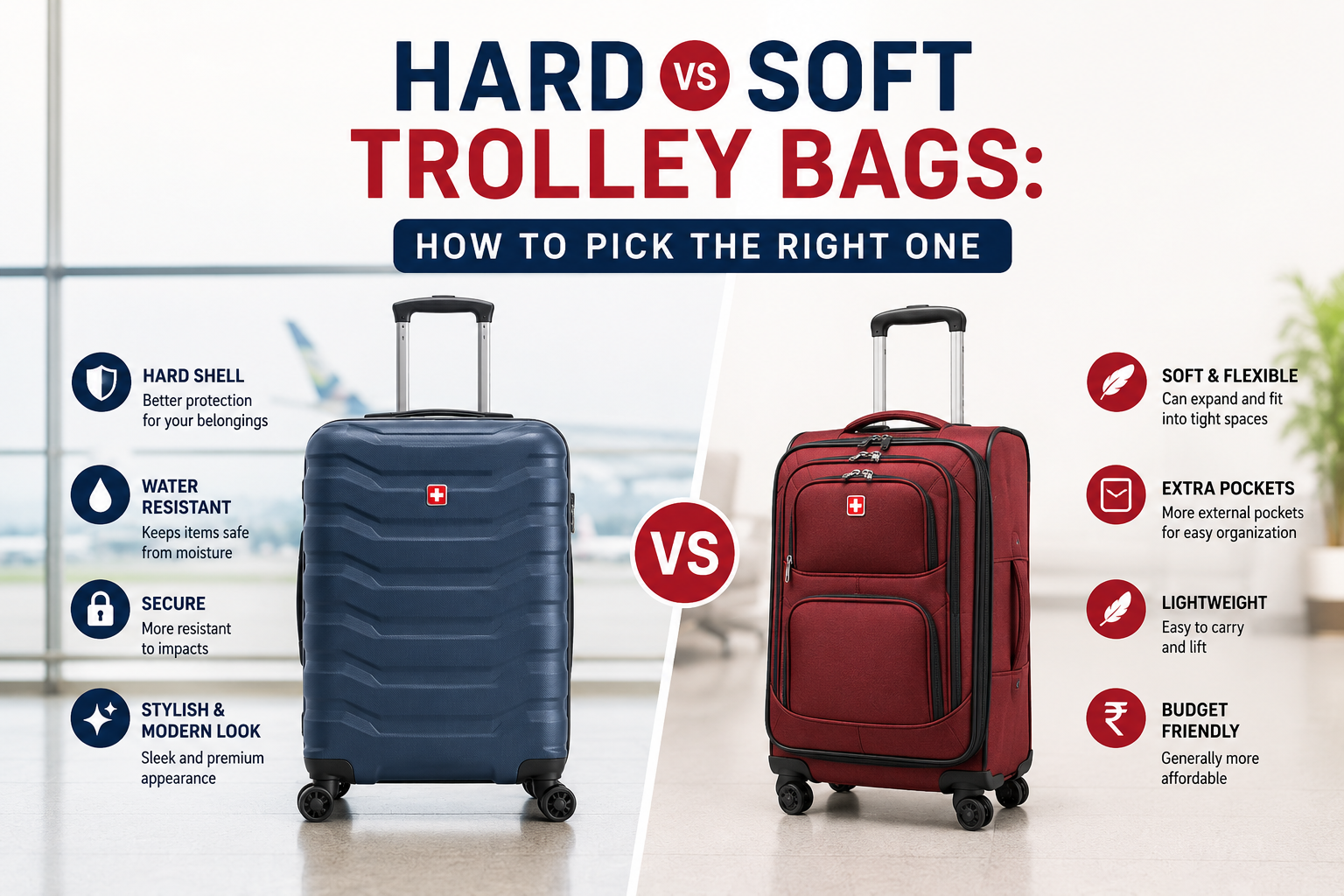
Neither wins every time. Hard trolleys protect what is inside better. If you pack fragile things like a camera, a laptop sleeve, gifts or glass bottles, the rigid shell takes the knock instead of your stuff. They also handle rain well, which matters during the monsoon when a bag spends a few minutes on a wet airport trolley or a damp station platform.
Soft trolleys are more forgiving in other ways. They squeeze into tight car boots and overhead bins, and they have outside pockets for a charger, a bottle or a train ticket. If your trips are mostly road or rail, a soft bag often makes more sense.
So if you fly often and pack breakables, lean hard. If you move around by road and want something flexible, lean soft. Most people who travel a lot end up owning one of each.
Is hard luggage better?
Better at protection, yes. Better at everything, no. Hard luggage is harder to squeeze into a full boot, it shows scratches (especially glossy finishes), and you cannot stuff a few extra things in the way you can with fabric. You also lose the outside pockets, though many hard bags make up for it with a divided interior and an expandable zip.
If you want to see what is available before deciding, this selection of hard trolley bags shows the range of sizes, locks and shell materials you will run into while shopping.
Which trolley material is unbreakable, and which is the strongest?
Here is the awkward truth: no material is truly unbreakable. Anyone who says so has not watched a baggage handler at work.
What you can do is pick a material that fails gracefully. Polycarbonate is the usual answer for the strongest hard luggage. It is flexible, so it bends under impact and snaps back instead of cracking. Polypropylene behaves in a similar way and tends to be a little lighter and cheaper. ABS plastic is the budget option. It is rigid, which means it can crack under a hard hit, especially in cold conditions or when the bag is overloaded.
On the soft side, the strongest fabrics are ballistic nylon and high-denier polyester. Look for a denier rating on the product page. A higher number generally means a tougher weave.
For the strongest luggage overall, look past the shell. Zips, wheels and handles fail long before the body does. A polycarbonate bag with a flimsy zip will let you down sooner than a well-built fabric bag with a good one.
Do hard suitcases crack easily?
Cheap ones can. A thin, brittle ABS shell packed to the brim and thrown onto a belt is the classic case. Polycarbonate and polypropylene cases are much less likely to crack, though they can still scratch, dent slightly or lose a wheel.
A few habits help. Do not overpack so the shell is under constant pressure. Do not sit on the bag to close it. And check the wheels when you buy, because that is where a lot of hard suitcases actually give up.
Which body is best for a trolley bag, and is cloth or plastic better?
People usually mean “which material,” and the choice really comes down to cloth versus plastic.
Cloth, meaning polyester or nylon, is light, flexible and good at fitting awkward spaces. It can soak up water and stains more easily, although most decent bags have a water-resistant coating. Plastic, meaning polycarbonate, polypropylene or ABS, protects contents better, wipes clean in seconds and keeps its shape.
If you want a single recommendation: polycarbonate for flights, good fabric for road and rail trips.
Can I fit more in a hard or soft suitcase?
Soft wins on raw capacity in practice. The fabric gives a little, so you can squash in one more shirt, and the outside pockets add useful space. A hard case has a fixed volume. What you see is what you get, unless the bag has an expansion zip.
That said, hard bags are often easier to pack neatly. The two clamshell halves hold dividers and straps, so things stay put and you waste less space.
Which type of luggage is lightest, and which material is lightweight?
Soft luggage is usually lighter because there is no rigid shell. But the gap is smaller than it used to be. Polypropylene hard cases are surprisingly light, and a cabin-size one can weigh about the same as a padded soft trolley.
This matters more than people think. Airlines count the empty bag in your allowance, so a heavy bag eats into what you can pack. Check the listed weight before you buy, not just the dimensions.
What is soft luggage?
It is simply a bag with a fabric body, usually polyester or nylon over a light frame, with a telescopic handle and wheels. Duffle trolleys, laptop overnighters and expandable upright suitcases all fall into this group. If you want to compare styles, there is a fair spread of soft trolley bags across duffle, overnighter and upright formats.
Which soft luggage is best?
The best soft bag is the one with the right fabric, strong stitching and decent wheels. Check the fabric rating, then look at the zip quality, the handle’s stability when fully extended and whether the wheels spin smoothly. Four-wheel spinners are easier on the wrist, and two-wheel bags tend to be more durable on rough surfaces like Indian railway platforms.
For business trips, a laptop overnighter with a padded compartment is the practical pick. For family trips, a larger expandable upright usually serves better.
Which hard luggage is best?
Skip the brand for a moment and look at four things: shell material (polycarbonate if you can afford it), a TSA-style lock, spinner wheels that feel solid, and a handle that does not wobble. A cabin-size 20-inch is the most useful single bag if you travel light. A 24-inch suits a week’s trip, and a 28-inch is for long stays.
How much does a 30kg trolley bag cost?
A bag that can carry 30kg is usually a large 28-inch trolley. In India, prices for these vary a lot. Expect roughly ₹5,000 to ₹15,000 for a decent large hard or soft bag, with premium polycarbonate or aluminium-frame models going well above that. Prices change often with sales and sizes, so check the current listing.
One practical warning. Being able to carry 30kg does not mean you are allowed to. Domestic economy check-in limits are often much lower, so look at your airline’s baggage rules before you fill a large bag.
Which trolley company is best, and what are the top brands?
There is no single best. Brands that come up most often in India include VIP, Safari, Skybags, American Tourister and Samsonite, and Swiss Military is another name you will see on both hard and soft ranges. Each has strengths. Some lead on price, some on design and some on after-sales service.
So judge the specific model, not the logo. Read the material, the warranty terms and recent buyer reviews. A well-built mid-range bag from any of these will usually outlast a poorly made premium one.
Which type of luggage bag is best overall?
If you want one answer: a polycarbonate or polypropylene hard trolley in 24 inches for most flyers, and a good fabric duffle or upright for people who travel mostly by road or rail. If you have room for both, buy both.
A quick way to decide
Pick hard if you fly often, pack fragile items or travel in the rains. Pick soft if you need flexibility, outside pockets and a lighter bag. Whichever you choose, spend your money on the zip, the wheels and the handle first, and the shell or fabric second. Those three parts are what decide whether a bag lasts two trips or two hundred.
 Oscar James S
 Brendly French