

Introduction
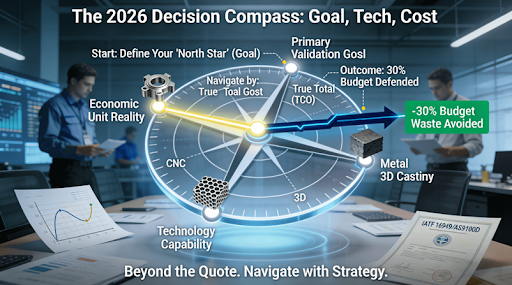
For example, for engineers designing prototypes of high-performance metal parts, there is a paralyzing decision between CNC machining, which offers guaranteed lead times at a high cost; metal 3D printing, which offers unparalleled freedom of design but raises questions of material performance; and rapid casting, which works well for small batches but raises questions of surface finish. This ambiguity in process selection can result in up to 30% of the overall prototyping budget being wasted in trial and error or in processes that are not well aligned with overall validation goals. This is because current decision-making is often driven by vague considerations of “complexity” or unit costs, instead of being well aligned with a well-defined “primary validation objective” and “Total Cost of Ownership” that includes hidden costs like iteration risk and post-processing costs.
This article will serve as a data-informed decision framework for 2026, defined by the “Goal Cost Dual Drive” approach. Rather than taking the basic approach of comparing features, the article will use quantified analysis to determine the absolute advantages and breakeven economics for CNC, Casting, and Metal 3D Printing technologies in overcoming the three core challenges: geometric fidelity, material state authenticity, and economic lot size. Using the framework presented in this article, you can lock in the most cost-effective and efficient validation approach for each stage of your project, eliminating budget blowback and minimizing your time to market. To begin using the framework presented in this article, you must establish the indisputable “Primary Validation Task” for your prototype.
Is Your Prototype Meant to “Fit,” “Function,” or “Endure”? Defining the Non-Negotiable Goal
This section sets the stage for decision-making, differentiating between the fundamental reasons for creating your prototype, as the optimal manufacturing process is entirely dependent on the non-negotiable goal.
1. Form and Fit: Validating Physical Assembly
If the prototype’s sole purpose is to prove that it physically fits inside an enclosure or with another object, then accuracy in size and surface finish is all that matters. Material properties are of little concern. In this case, CNC machining is usually a winner, offering unmatched accuracy and surface finish with minimal post-processing required. Operations that require significant shrinkage or require extensive support removal can introduce many unknowns that may not easily fit into a “proof of fit” scenario.
2. Functional Performance: Simulating Real-World Behavior
If a prototype is required to perform under mechanical, thermal, or fluid dynamic stresses that mimic those it would experience in a real-world environment, then material properties are of critical concern. A prototype that fits perfectly may not perform well when subjected to stresses that it would naturally experience in a real-world environment. If a part is to undergo a traditional manufacturing process like casting or forging, then a prototype created using that exact process (e.g., rapid casting) is usually the only option that would even begin to mimic the grain structure and possible defect modes that a CNC or 3D printing process would not offer.
3. Endurance and Lifecycle: Predicting Failure Modes
The most challenging validation requirement is to predict endurance or lifetime. For this requirement, it is essential that the microstructure, porosity, and residual stress of the prototype resemble those of the production intent as closely as possible. For this requirement, it is essential to select a process that closely resembles the production intent or is at least known for its property equivalency. For such a high-level requirement, it is essential to align with it first in order to select any process effectively for any requirement. This is because of the support of various frameworks like the Digital Thread for manufacturing by organizations like NIST. For better and in-depth knowledge of the capabilities of these three processes and quantified economical models and decision trees validated through huge data available for various projects related to rapid prototyping for metal parts, an exhaustive in-depth guide is available.
CNC vs. Metal 3D Printing: Where is the True “Cost Crossover” for Complex Geometries?
In this section, we will use data to demystify the cost crossover between CNC and Metal Additive Manufacturing (SLM/DMLS), and demonstrate that complexity is not a good predictor for cost.
1. The Unit Economics of “One-Off” vs. “Batch” Production
While the economics between the two technologies is often presented as a static analysis, it is, in fact, dependent on the number of units to be produced. In the case of 1-2 units of a complex part, such as a titanium alloy part with internal channels, CNC machining may be more cost-effective. The high cost of 3D printing’s setup and material is not yet justified for such a small number of units, and the digital programming advantage of CNC is meaningless for a single unit.
2. Identifying the Economic Inflection Point
Generally, the curves cross over at a point between 3 and 5 units. At this point, the “batch” economics of 3D printing begin to outweigh its high fixed costs. At this point, 3D printing’s unit costs begin to drop significantly, whereas CNC’s unit costs drop only slightly as a result of linear time increases with quantity. Beyond 10 units, 3D printing’s unit costs level off and are typically below CNC’s unit costs for a highly complex part.
3. The Hidden Variables: Build Volume Utilization and Post-Processing
As it turns out, “complexity” is not a variable in 3D printing’s favor. Rather, it is build volume and post-processing costs that are key drivers of 3D printing’s costs. A 3D printing part that packs the build chamber efficiently will have significantly lower unit costs compared to a CNC part that requires expensive custom fixturing and 4-axis and 5-axis machining. Moreover, significant labor costs in 3D printing, such as removing supports, relieving stresses, and HIP treatment, also need to be considered in a fair TCO comparison.
When Does “Rapid Casting” Transition from a Niche to the Most Strategic Choice?
This section redefines the strategic value of rapid casting, not as the last resort but rather as an essential step to production for particular validation objectives.
- The Unmatched Benchmark: Material and Process Fidelity: Rapid casting, via 3D-printed sand molds or investment patterns, is the strategic and non-negotiable choice when the final production part must be a casting. It is the only prototyping method capable of faithfully validating the material soundness and defect likelihood of the selected alloy (e.g., A356 aluminum, ductile iron) for a near-identical thermal environment. A CNC-machined or 3D-printed prototype made from an analogous alloy cannot accurately simulate the solidification characteristics of a true casting, rendering it invalid for particular functional validation.
- The Small-Batch Economics Sweet Spot: For bridge production, i.e., production runs between 10 and 50 pieces, rapid casting can be the best economic solution. Although there is a fixed cost per mold, there is considerable saving in metal part cost as soon as the pattern cost is amortized. For specific part geometries and production volumes, the total cost of a rapid cast batch can be lower than both CNC machining (due to machine time) and metal 3D printing (due to powder and machine time costs), making it an attractive option for pre-series validation production and initial market launches.
- The Digital Bridge to High-Volume Production: Rapid casting is an ideal digital bridge to traditional high-volume production tooling. The 3D printed molds used in rapid casting prototypes offer invaluable insight into gating, risering, and cooling, which can be applied to optimize traditional tooling designs. This reduces the risk of costly tooling investments necessary for high-volume production. Hence, turning a science-based process selection into a high-fidelity, immediately testable part is only possible with a partner offering extensive process options and supporting engineers — a competent rapid prototyping service.
The Hidden Cost Drivers: What Your Quote Doesn’t Show About Post-Processing & Risk
This section will dissect the often overlooked aspects of Total Cost of Ownership, extending beyond the initial quote to include post-processing and project risk.
1. The Unseen Labor and Equipment Sink
While initial quotes are typically based on an initial machining, printing, or casting price, it is in the post-processing phase where significant hidden costs are incurred. For metal 3D printing, this includes manual removal of supports, stress relief heat treatment, Hot Isostatic Pressing (HIP), and machining or blasting. For CNC machining, it includes the often overlooked design and machining of complex fixtures, as well as alignment errors due to multiple setup issues. For casting, it includes mold corrections, extensive machining allowances, and fettling.
2. Quantifying Iteration Risk and Design Change Impact
The cost of an unsuccessful test or design change can range from low to extremely high, depending upon the process. This is an important hidden factor. A dimensional adjustment in a CNC program can be done very quickly and at little cost. A topological change in 3D printing may only involve creating a new program, although this does involve rebuilding the entire object. A design change in casting, however, can involve changing or rebuilding the mold, which can be very costly and involve a significant time penalty. A process with a low iteration risk for this early-stage, volatile design stage is an excellent optimization of the supply chain.
3. Building a Holistic TCO Model for Decision-Making
A solid decision process begins by creating a basic TCO model to include the following components: 1) Upfront/NRE Costs (programming, fixture design, mold/pattern creation), 2) Per-Unit Variable Costs (material, machine time, labor), 3) Per-Unit Post-Processing Costs, and 4) a Risk-Adjustment Factor for expected iterations based upon design maturity. This holistic approach avoids the common mistake of choosing the process with the lowest upfront quote, which may actually have the highest total project cost and timeline.
The 4-Question Supplier Audit: Are You Getting a Sales Pitch or a Strategic Consultation?
This section is a practical tool to help you determine whether a supplier is capable of offering you a strategic consultation based on the success of your project, or simply a sales pitch.
1. Demanding Data-Driven Scenario Analysis
A strategic partner should be able to offer rough cost/quantity curve comparisons for CNC, metal 3D printing, and casting technologies in relation to your particular validation objective and anticipated batch size. For example: “Can you break down for me what drives costs for each of these technologies for my part in quantities of 1, 5, and 20?” This is asking for analysis and transparency, moving beyond capabilities and into economics.
2. Probing Iteration Strategy and Historical Proof
Every prototype has its chance of failure. A consultative supplier should be willing to walk through iteration strategy with you. Ask: “If my first-round test fails and I must make a design change, what would be the quickest and most cost-effective iteration strategy from your set of offerings, and why?” Additionally, ask: “Can you provide a sanitized case study or data on comparative results of functional tests (e.g., fatigue, pressure) on prototypes of an equivalent part made via different processes from your offerings?”
3. Verifying Systemic Quality and Data Integrity
For prototypes in regulated industries or for de-risking production, the quality system of the supplier is of utmost importance. Instead of asking, “Do you have a quality certification?” ask, “How does this quality certification help me?” Ask, for example, “How does your AS9100 quality certification for the aerospace industry or your ISO 13485 quality certification for the medical industry, for example, guarantee me full traceability of the batch of the material and the process parameters of my prototype, and how does this data structure help me for the qualification of the production process later?” A quality-conscious rapid prototyping supplier following quality standards such as IATF 16949 has an APQP process in place, where data integrity for material, process parameters, and inspection results must be recorded from the prototype phase itself, thus ensuring data continuity and greatly reducing transfer risk to mass production. This is the kind of robust rapid prototyping supplier selection process to find yourself an actual partner.
Conclusion
In the world of 2026 manufacturing, choosing a metal prototyping process has moved from a technical exercise to a strategic discipline that incorporates verification science, cost engineering, and risk management. With a decision methodology that employs “Validation Goal” as its “North Star” and “Total Cost of Ownership” as its “compass,” it is now possible to turn what has been a cost center of uncertainty into a fundamental competitive advantage that drives innovation, reduces risk, and speeds time-to-market. Knowledge of and navigation through the economics and capability of these technologies is critical to attaining a competitive advantage.
FAQs
Q: Can the properties of 3D printed metal parts realistically achieve the properties of wrought or forged parts?
A: Yes, after Hot Isostatic Pressing and heat treatment, the static tensile properties of SLM parts can achieve and even exceed those of forgings. However, fatigue properties, especially high cycle fatigue, tend to be less than those of forgings because of micro-porosity and anisotropic microstructure. This is an important factor for dynamically loaded components and must be factored into the process.
Q: What is the realistic timeframe for creating CNC, 3D printed metal, and rapid casting prototypes?
A: The timeframe for creating prototypes is dependent on the process. CNC machining is the quickest process and has a realistic timeframe of 5-10 working days for medium-complexity parts. 3D printed metal (SLM) has a timeframe of 7-14 working days, depending on whether stress relieving heat treatment is required. Rapid casting has a longer timeframe, taking 10-20 working days depending on the complexity of the mold and the amount of machining required.
Q: If my prototype fails testing, which process allows for the lowest, cost and fastest design iteration?
A: The best process depends on the type of design change you intend to make. If it is only a minor dimensional adjustment, CNC machining is usually the least expensive and quickest way to do the iteration because it may only need a minor program change. However, for topological changes and internal lattice redesign, metal 3D printing is great because of its “digital tooling”, only a revised CAD file is needed. Casting is normally the most expensive and slowest method because it requires mold modifications or remakes.
Q: How do you ensure the prototype material and process data is valid for production scaling?
A: A strong approach is to implement a “digital thread” from prototype to production. That means certified material batches, detailed process parameters (e.g. laser power and scan speed for SLM; toolpaths for CNC), and inspection data from the prototype phase are carefully recorded in a structured database. This dataset is then used as the benchmark for process qualification during production ramp, up, that way you have a knowledge transfer without hiccups and lower re, validation efforts.
Q: Do you support hybrid manufacturing, combining different processes for a single prototype?
A: I support it 100%. Sometimes when parts are complex hybrid manufacturing is a very good approach and can be a way to play to each technology’s strengths.
Author Bio
This piece of writing is a reflection of the author’s extensive project work and interaction with global high, tech industries, through manufacturing of highly complex metal parts from prototype to production stage. Being a manufacturing partner certified to ISO 9001, IATF 16949, and AS9100D standards, LS Manufacturing provides diverse CNC, additive, and casting services and creates illusions of offering clients independent, data, driven decision, making tools and high, fidelity prototype production Along the way, questions the developmental steps of your critical metal component? Submit your 3D model and validation objectives right now for a free Multi, Process Rapid Prototyping Comparison & Total Cost Simulation Report.
 Oscar James S