
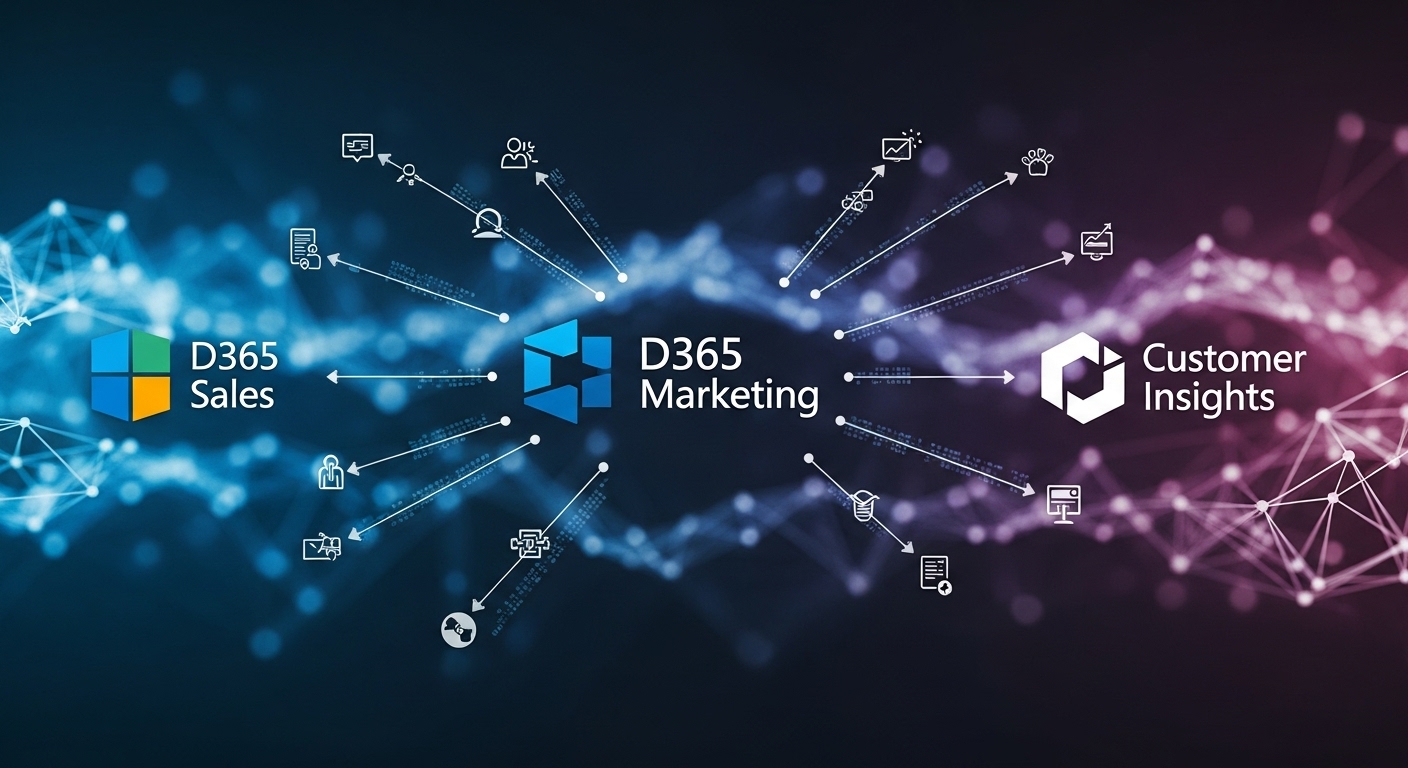
Marketing, sales, and analytics teams often work with the same customer data but experience it very differently. Marketing sees engagement signals, sales focuses on pipeline movement, and analytics teams interpret patterns after the fact. When these perspectives remain disconnected, organizations struggle to deliver consistent customer experiences.
The challenge is rarely about missing tools. Most organizations already run capable platforms across engagement, relationship management, and reporting. The gap appears when these systems operate independently, forcing teams to rely on partial context and delayed insights.
For organizations using Dynamics 365 Marketing, integration with Sales and Customer Intelligence becomes the difference between coordinated growth and fragmented execution.
How Integration Changes the Customer Engagement Model
True integration does more than move data between systems. It aligns intent, timing, and context across teams that influence the customer journey. When marketing, sales, and insights operate from the same foundation, decisions become faster and more consistent.
-
Aligning Customer Data Around a Single Narrative
Customer journeys rarely follow linear paths. Prospects engage with campaigns, interact with sales, pause, return, and change behavior over time. When systems are disconnected, each team sees only part of that story.
Integration creates continuity. Engagement data, relationship history, and behavioral signals combine into a shared narrative. This alignment allows teams to understand not just who the customer is but also where they are in their decision-making process.
-
Connecting Engagement Signals to Revenue Motion
Marketing activity generates signals, but those signals only matter when they influence action. Integrated environments allow high-intent behaviors to surface directly within sales workflows.
Sales teams gain context around what content resonated, which campaigns drove interest, and how engagement evolved. This context improves prioritization and enables more relevant conversations without relying on manual handoffs.
-
Using Unified Insights to Refine Targeting
Customer Insights adds depth by identifying patterns that are not immediately visible in transactional data. Segmentation based on behavior, propensity, or engagement trends allows marketing efforts to become more precise.
When these insights inform campaign design and sales outreach, targeting improves across the funnel. Teams move beyond broad personas toward data-backed audience definitions that adapt as behavior changes.
Where Integration Often Breaks Down
Despite platform capability, many integrations underperform because foundational elements are overlooked. Technical connectivity alone does not guarantee alignment.
-
Inconsistent Definitions Across Teams
Marketing, sales, and analytics often define key concepts differently. A qualified lead, an active customer, or an engaged contact may carry different meanings depending on the function.
Without alignment on definitions, integrated systems amplify confusion rather than resolve it. Establishing shared terminology ensures insights translate into consistent action.
-
Data Quality and Identity Gaps
Integration exacerbates existing data issues. Duplicate records, missing identifiers, and inconsistent attribute usage weaken confidence in insights and reduce adoption.
Addressing identity resolution and data hygiene early prevents mistrust from spreading across connected systems.
Building Integration That Supports Daily Work
Integration succeeds when it supports how teams already operate, rather than forcing new habits that slow execution.
-
Surfacing Insights Inside Sales Workflows
Sales teams are unlikely to switch systems to find context. Integrated environments should deliver engagement and insight signals directly within familiar interfaces.
In organizations running Dynamics CE, this approach allows sellers to act on marketing intelligence without disrupting their workflow, improving responsiveness and adoption.
Designing Marketing Journeys with Sales Context
Marketing automation performs best when it reflects sales reality. Integration enables marketers to design journeys that adapt based on opportunity stage, sales activity, or customer status.
This coordination prevents over-communication and ensures outreach remains relevant throughout the buying cycle.
Governance Keeps Integration Sustainable
Integration is not a one-time effort. As campaigns evolve, pipelines change, and customer behavior shifts, governance becomes essential to maintain alignment.
-
Clear Ownership Across Functions
Each system requires defined ownership. Marketing owns the engagement strategy, sales owns the relationship progression, and analytics owns the integrity of insights. When responsibilities are explicit, integration remains purposeful rather than ambiguous.
Shared governance forums help teams review performance, refine definitions, and align on activation strategies.
-
Monitoring Impact, Not Just Activity
Success should be measured by outcomes rather than volume. Engagement rates, conversion efficiency, pipeline velocity, and retention trends provide a clearer picture of whether integration delivers value.
This focus keeps integration aligned with business goals rather than technical metrics.
Preparing Teams for an Integrated Operating Model
Technology integration changes how teams work. Without preparation, even well-designed systems remain underutilized.
-
Training Around Decisions, Not Features
Teams adopt integrated platforms faster when training focuses on real scenarios. Showing how insights guide outreach, qualification, or follow-up builds confidence and relevance.
Feature knowledge matters, but decision clarity drives behavioral change.
-
Encouraging Feedback and Iteration
Integrated environments improve through use. Early feedback highlights friction points, unclear signals, or missed opportunities for refinement.
Organizations that treat integration as iterative rather than final achieve stronger alignment over time.
Conclusion: Integration as a Growth Multiplier
Integrating D365 Marketing with Sales and Customer Insights reshapes how organizations engage customers. It replaces isolated activity with coordinated motion and replaces delayed reporting with timely context.
When marketing, sales, and insights operate as a connected system, organizations gain more than efficiency. They gain clarity on customer intent, confidence in decision-making, and the ability to respond more quickly as behavior evolves.
The result is not just better campaigns or cleaner pipelines, but a more adaptive organization built around a shared understanding of the customer.