

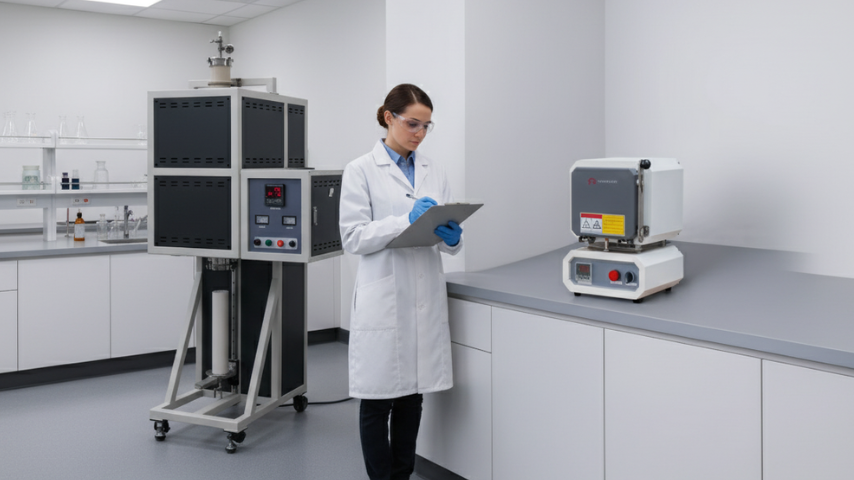
High-temperature processing requires stable, isolated environments to achieve reliable results. Selecting the right muffle furnaces allows researchers and engineers to heat materials without direct exposure to heating elements or combustion gases. This isolation provides the thermal uniformity required for processes ranging from simple ashing to complex sintering of advanced ceramics.
The primary challenge for most buyers involves distinguishing between the various temperature classes and chamber sizes available. A furnace that reaches 1200°C serves different needs than a high-temperature model capable of 1800°C. This guide focuses on the selection logic required to match a specific thermal process with the most appropriate hardware. Comparing muffle furnaces from Torontech provides a practical starting point for evaluating both laboratory and industrial configurations.
What a Muffle Furnace Is Actually Helping You Control
Achieving desired material properties depends on precise temperature management over time. A Muffle Furnace provides a high degree of process control by isolating the sample within a refractory-lined chamber. This setup secures several key factors:
- Thermal Uniformity: Heat remains consistent throughout the chamber volume to prevent localized failures.
- Repeatable Heating Cycles: Digital controllers manage ramp rates and soak times for consistent batch-to-batch results.
- Material Integrity: Samples remain protected from contaminants potentially found in the furnace heating elements.
- Stable Testing Conditions: Reliable heating supports R&D and quality assurance programs for diverse material types.
Managing these variables is necessary for success in metallurgy, ceramics, and analytical chemistry. Reliable muffle furnaces turn thermal processing from a variable into a constant.
Start With the Thermal Process, Not the Furnace Label
Selection logic should begin with the specific thermal task rather than a model number. Different materials respond uniquely to heat, requiring specific environmental conditions. Identifying the end goal helps narrow the search for appropriate hardware.
Consider the following questions when auditing your needs:
- Are you performing ashing or gravimetric analysis to determine moisture or mineral content?
- Are you sintering ceramics or advanced nanomaterials that require specific dwell times?
- Are you heat treating metals and alloys to alter hardness or ductility?
- Are you firing dental or specialty ceramic products?
- Is the workflow mostly research and development (R&D) or continuous production support?
Thermal process requirements dictate the insulation type, heating element material, and controller sophistication needed. Matching the furnace to the task helps the equipment survive the intended duty cycle.
Laboratory Muffle Furnace vs Industrial Use: The Core Difference
Thermal processing environments generally fall into two categories based on the scale and frequency of use.
Laboratory Muffle Furnace
Laboratory settings prioritize precision and flexibility. A Laboratory Muffle Furnace is often the primary choice for materials development, analytical chemistry, and quality control. These units accommodate smaller samples and varied heating profiles. They provide the repeatable methods needed for gravimetric analysis and experimental sintering without occupying excessive bench space. These systems are optimized for accuracy and ease of use in a research setting.
Industrial-oriented muffle furnace use
Manufacturing and production environments require a different level of durability. Industrial models handle heavier loads and more frequent cycling. These systems support manufacturing tasks like bulk heat treatment and sustained firing of ceramic components. Throughput and mechanical robustness take priority over compact convenience. Choosing an industrial-oriented system helps the furnace withstand the rigors of sustained, high-volume operation.
Core Applications That Usually Drive Furnace Selection
Specific industries drive the need for specialized thermal hardware. Understanding these applications helps in selecting the right chamber configuration.
- Materials Science: Evaluating the behavior of new polymers, metals, and composites.
- Analytical Chemistry: Performing ashing and gravimetric tests for chemical purity.
- Metallurgy: Managing annealing, hardening, and tempering of metal samples.
- Ceramics and Dental: Firing prosthetic materials and advanced technical ceramics.
- Aerospace and Energy: Sintering high-performance coatings and battery materials.
Each application requires a specific balance of ramp speed and cooling behavior. Muffle Furnaces for Laboratory Testing provide the accuracy needed to validate these processes before they scale to production.
Temperature Range: When 1200°C Is Enough and When You Need More
Thermal limits define the operational life of the heating elements and insulation. Most routine lab work and basic quality control (QC) tasks fit within the 1000°C to 1200°C range. Using a furnace at its absolute limit for extended periods causes premature wear.
High-temperature models reaching 1400°C, 1700°C, or 1800°C are necessary for specialized materials. Sintering advanced ceramics, processing nanomaterials, or performing high-temperature metallurgical research requires these specialized heating elements. Common materials for these ranges include silicon carbide or molybdenum disilicide. Identifying the real-world temperature needs prevents overspending on expensive high-temp elements when a standard class would suffice.
Why Programmable PID Control Matters
Precision thermal profiles require sophisticated management beyond a simple thermostat. Torontech systems utilize programmable PID (Proportional-Integral-Derivative) control to execute complex heating cycles. This technology is necessary for:
- Annealing: Controlled cooling to reduce internal stresses.
- Sintering: Holding precise temperatures to bond particles without melting.
- Hardening: Exact ramp rates to achieve specific molecular structures.
Repeatable profiles help research findings remain reproducible. This level of control is a key feature of Muffle Furnaces for Laboratory Testing used in modern R&D programs.
Selection Framework: How to Choose the Right Muffle Furnace
The procurement process can be simplified by aligning specific lab needs with the following scenarios:
Choose a compact or smaller Laboratory Muffle Furnace when…
Sample sizes are limited and the lab runs varied research projects. This format benefits facilities where floor space is limited but precision is required. These units favor labs that value easy day-to-day operation and fast setup for small batches.
Choose a larger laboratory or mid-capacity system when…
Batch volumes are higher and multiple users share the same equipment. These systems accommodate broader material testing needs and frequent thermal cycles. They provide a practical balance between lab precision and production-level throughput.
Choose a higher-temperature or more industrially oriented system when…
The process requires thermal ranges above 1400°C on a regular basis. These models serve heavy-duty cycles in manufacturing support. Durability and sustained use are the primary decision drivers for these high-performance systems.
What Buyers Should Define Before Requesting Quotes
Audit your laboratory requirements to provide the following information before requesting a quote:
- Primary application (ashing, sintering, heat treating).
- Typical sample size and total batch volume.
- Temperature range actually required versus maximum furnace limit.
- Laboratory testing versus production-support workflow.
- Frequency of use (intermittent versus continuous).
- Chamber size and footprint requirements.
- Complexity of required thermal profiles.
- Safety and containment needs.
- Potential for future expansion into higher temperatures.
Common Buying Mistakes
- Choosing based on maximum temperature only without considering element life.
- Purchasing a chamber much larger than the typical sample load, wasting energy.
- Selecting a basic controller for a process that needs complex ramping and holding.
- Treating laboratory and industrial duty cycles as identical.
- Ignoring the requirement for atmosphere control if materials oxidize easily.
- Focusing on the machine price while ignoring long-term maintenance costs.
Why Buyers Compare Muffle Furnaces on Torontech
Torontech offers a wide range of thermal solutions, from compact Muffle Furnaces for Laboratory Testing to high-capacity industrial units. The lineup covers temperature classes from 1200°C to 1800°C. This diversity allows buyers to select a system based on actual application needs rather than a limited inventory. The organization categorizes its systems by workflow, making it easier to compare muffle furnaces for laboratory testing alongside heavy-duty models. Explore Torontech muffle furnace options to see how these systems align with specific industrial and research standards.
Explore Muffle Furnaces from Torontech
The success of material characterization and production workflows depends on the correct thermal environment. Compare muffle furnaces for laboratory testing on Torontech helps laboratories identify the specific chamber size and temperature class required. Defining the real application first leads to a more successful equipment selection.
Explore muffle furnaces from Torontech and request a quote for the laboratory or industrial thermal processing system that fits your testing workflow.
 Wild Rise
  Brendly French