

Introduction
For example, in the fields of medical devices, high-end consumer electronics, and display devices, acrylic (PMMA) is often chosen as an ideal material due to its high transparency and beauty. Yet, as designers and engineers attempt to transition from design into a high-precision physical part, there are many widespread issues related to warpage, chipping, scratching, and maintaining dimension within ±0.1mm. The root cause is not related to the material; rather, it is related to a lack of comprehension of acrylic’s thermal sensitivity and internal stresses, as well as the improper application of machining processes and parameters. The application of generic CNC machining strategies to acrylic materials will inevitably cause quality defects related to heat accumulation and improper tooling selection.
This paper breaks down the main three problems of high, precision acrylic machining step by step, i.e. thermal management and deformation controls, perfect edge formation, as well as achieving optical, grade surface finishes, and it also provides a comparison of the advantages and disadvantages of different levels of machining approaches. What is more, it offers a very straightforward framework by which one can evaluate and choose the professional CNC machining suppliers so that your project is protected even before it starts.
Why is Acrylic (PMMA) CNC Machining Considered Challenging? Key Difficulties
Acrylic, often referred to as the “Queen of Plastics” because of its excellent clarity and resistance to weathering, somehow offends the machinist side as well: the very properties that make it so attractive for the final application render it quite fragile during processing. The three major challenges that must be overcome in order to convert a block of acrylic into a high precision part are.
Inherent Material Challenges in Acrylic Machining
Acrylic presents two fundamental, material-driven hurdles during Acrylic CNC Machining. The first is its pronounced thermal sensitivity and tendency to deform, rooted in a low melting point and poor thermal conductivity. During cutting, heat concentrates at the tool edge, softening the material. This causes it to gum on tools, experience elastic spring back, and warp, directly compromising dimensional accuracy. Standards like the Heat Deflection Temperature (HDT) from the American Plastics Industry Association (SPI) formalize this limit, making active thermal management non-negotiable.
- The Problem of Brittle Fracture
Acrylic, lacking metal-like ductility, is prone to sudden brittle fracture under machining stress. This inherent property makes it susceptible to cracking rather than deforming plastically when cut.
- Impact on Edge Quality and Integrity
The second major challenge is acrylic’s brittleness and susceptibility to edge chipping. Unlike ductile metals, improper machining parameters—such as using a dull tool, excessive feed rate, or a suboptimal toolpath—can cause a crushing or cracking action instead of a clean shear. This results in micro-cracks, chipping, or a ragged edge, particularly during drill exit or cutoff operations, detrimentally affecting both the component’s structural integrity and its visual appearance.
Achieving Optical-Grade Surface Finishes
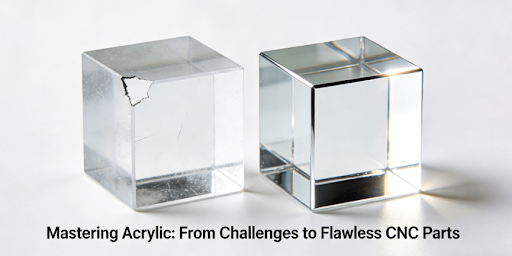
Beyond dimensional and edge integrity, maintaining and attaining perfect optical clarity stands as the paramount final challenge. Every surface flaw, from visible tool marks and fine scratches to hazing or an “orange peel” texture from improper polishing, acts as a light-scattering defect that degrades transparency. The journey from a machined surface to a flawless, polished finish requires meticulous, stage-specific control, as standard metal-finishing techniques are largely unsuitable for acrylic. Successfully navigating all these challenges demands exacting, in-depth control over every link in the production chain.
What is the Fundamental Difference Between Standard and Advanced CNC Machining for Acrylic?
The difference between a merely functional component and a perfect one is in the level of the approach method. Basic job, shop machining and dedicated advance CNC machining are not only different in their conception and working but also in the results they yield.
Process Strategy and Parameter Optimization
Where standard machining practices may use universal tools and liberal parameters, “advanced machining” uses a science. Advanced machining practices use tools that are “specifically designed for plastics,” such as single- or double-flute, polished spiral “O”-flute cutters, which are efficient at removing chips and minimizing heat generation. Advanced machining practices use high spindle speeds, low feed rates, and small depth of cuts, sometimes using a “cold air blast” or special coolants to achieve “cold machining,” which does not involve melting of plastics.
Stress and Distortion Management
One of the biggest mistakes with conventional machining operations is the failure to take into consideration the internal and induced stresses in the workpiece. This has been effectively addressed with the development of the more advance CNC machining protocols. This includes the use of fixtures to ensure even clamping, the use of climb milling, and the use of the step down machining process, which involves making multiple passes with the cutting tool and, in some cases, even pre-conditioning the raw material to relieve the stresses.
Sophisticated Post-Processing Techniques
- Mechanical Polishing
Although the regular polishing may result in the surface becoming smooth to the touch, the really high, level methods take place in specially controlled settings. They are composed of a series of steps using abrasives of progressively finer grit aimed at wiping out any signs of machining, and at the same time, bringing back the shine, frequently with the use of specially formulated buffing compounds.
- Chemical Polishing
Chemical polishing (e.g. using a vapor or dip process) is used for the best optical quality. It gently melts the surface layer of the acrylic and smoothes microscopic irregularities, thereby producing a finish with gloss unit (GU) value more than 100 often, resulting in a truly water, clear optical surface. This is the biggest difference between standard workshops and real professional CNC machining companies in terms of finishing ability.
How to Select the Best CNC Tools and Parameters for Perfect Acrylic Cutting Edges?
The cutting tool is the first and most important gatekeeper of edge quality. Choosing the best CNC bit for acrylic is very important. The best tool would be a sharp, highly polished single or double flute with optimized geometry (high rake and clearance angles) allowing for a shearing action that reduces cutting force and heat generation. Diamond, coated tools are very wear resistant and durable, providing a sharp cutting edge even after long use. Parameter setting is based on the basic principles: high spindle speed (e.g. 18 000+ RPM), low feed rate, and light depth of cut.
This way each tooth will only make a small clean cut thus no cut chip overload and heat will be generated. Besides the machining set, up, the use of a directed stream of compressed air is almost equally important as it not only evacuates chips from the cut zone preventing re, cutting but at the same time provides effective cooling both the workpiece and the tool. A dedicated engineering blog has great insights on the best CNC bit for acrylic for those interested in a detailed technical discussion on tool geometry and selection.
From Prototype to Production: Ensuring Batch-to-Batch Consistency for Acrylic Parts
Brand integrity and production efficiency both hugely depend on consistency, lately it has become a major concern for manufacturers world over. The good news is that consistency for acrylic CNC machining parts does not totally depend on the skill of an individual but rather on the standardization of the whole system carried out by a CNC machining parts factory. At this point, high precision CNC machining services is not just a mere feature but a true promise. … Everything is first done by the book from when you get a file, do the CAM programming, prepare machines, to final inspection.
Then First Article Inspection (FAI) with the help of coordinate measuring machines (CMM) or laser scanners checks the initial part with all critical dimensions. After that, periodic in, process checks are done through statistical process control (SPC) to monitor the drift. Controlling the environment is particularly crucial for acrylic; having a temperature and humidity, controlled machining environment can help in reducing thermal expansion, which is the main cause of dimensional variation. … To a great extent you cannot overlook the import of IATF 16949 (automotive) or ISO 13485 (medical) certifications because they not only require a very strict control of the process but also ensure the traceability that is the cornerstone for achieving the actual consistency. The professional Custom manufacturing services take this comprehensive system, oriented approach to present the ultimate value for their customers.
What Key Capabilities Beyond Price Should You Evaluate in a CNC Machining Supplier?
Choosing a supplier solely on the basis of unit price is really a very risky move. In fact, a detailed technical capability audit is the best way to find a partner that will actually help reduce project risk. It’s well worth checking a few basic capabilities of the potential CNC machining suppliers: the ability to work closely with engineering and the knowledge of DFM, meaning the supplier should be able to do a design review that not only identifies any errors but also improves the manufacturability of the part; a quality control system that is so good it has been certified to standards like ISO 9001 or AS9100D is the evidence, together with quality supporting documentation, of a high, standard system.
A very experienced suppliers like JS Precision in manufacturing a medical observation window to 0.02mm tolerance can serve as examples; lastly, full transparency of the entire end, to, end process in quoting and communication is a core element of a resilient supply chain, as noted in reports by the Royal Academy of Engineering. Only the comprehensive assessment of these capabilities guarantees the finding of a partner who will accurately turn design intent into an impeccable deliverable CNC machining part.
Conclusion
Successfully delivering the highest precision and wonderful appearance in acrylic components is a planned engineering work. Understanding deeply the characteristics and challenges of the material in machining is the first step, then it needs to be done through the accurate use of up, to, date advance CNC machining operations, and finally it depends on the thorough interaction with CNC machining suppliers who have strict quality controls and relevant experience. Not just simple pricing comparison but a technical capability audit is really the only way to avoid risk and guarantee the success of the project.
If you are looking for trustworthy manufacturing opportunities for stressful acrylic or other precision engineering plastic parts, the best way would be to start by thoroughly understanding your prospective partners full capabilities in high precision CNC machining services. Visit their process library and case studies today to get real ideas for your next project.
Author Bio
The writer serves as an expert guest contribution in the domain of advanced manufacturing technologies, materials engineering and industrial digital transformation. The author has a solid background of 10+ years in engineering research and industry analysis. The authors commitment is towards simplifying complicated technologies and offering industry, oriented, feasible insights.
FAQs
Q1: What dimensional accuracy can be achieved with acrylic CNC machining?
A: Ordinarily, with expert control, the main dimensional tolerances for acrylic pieces can go down to the range of 0.05mm to 0.1mm. For extremely demanding tasks, by means of specialized equipment and process optimization, tolerances as tight as 0.02mm are possible however this largely depends on the supplier’s technical capability.
Q2: How can you tell if a CNC machining supplier is proficient with acrylic?
A: Make very specific queries about their use of tools for acrylic, what they do to keep the temperature down, and how they polish. Ask for physical samples or detailed case photos of parts with similar complexity. Check the edge quality and surface finish thoroughly. Actual pieces have more weight than mere talking.
Q3: Can polished acrylic parts achieve transparency comparable to glass?
A: Granted. Professional mechanical polishing paired with chemical polishing of acrylic parts, result in light transmittance over 92% and surface gloss (GU) around 100 or higher. To the naked eye, the finish of the acrylic is extremely clear and nearly indistinguishable from glass, making it a very attractive substitute for glass in a myriad of applications.
Q4: What is the greatest risk when machining complex, thin, walled acrylic structures?
A: The main hazards are vibration and heat, caused deformation during cutting, as well as stress whitening or even fracturing caused by clamping pressures. Reducing the risk involves ripple effect of simulated analysis, reworked toolpaths, specially made fixtures, and multi, step machining processes for stress relieve.
Q5: What are the main process differences between small, batch acrylic prototypes and high, volume production?
A: Prototyping aims at speedy design validation and usually employs flexible programming and adaptable fixtures. On the other hand, mass manufacturing targets uniformity, effectiveness, and cost reduction, which require dedicated fixtures, tightly controlled and optimized machining programs, and the use of Statistical Process Control (SPC) to ensure each batch is within the specification.
 Oscar James S