

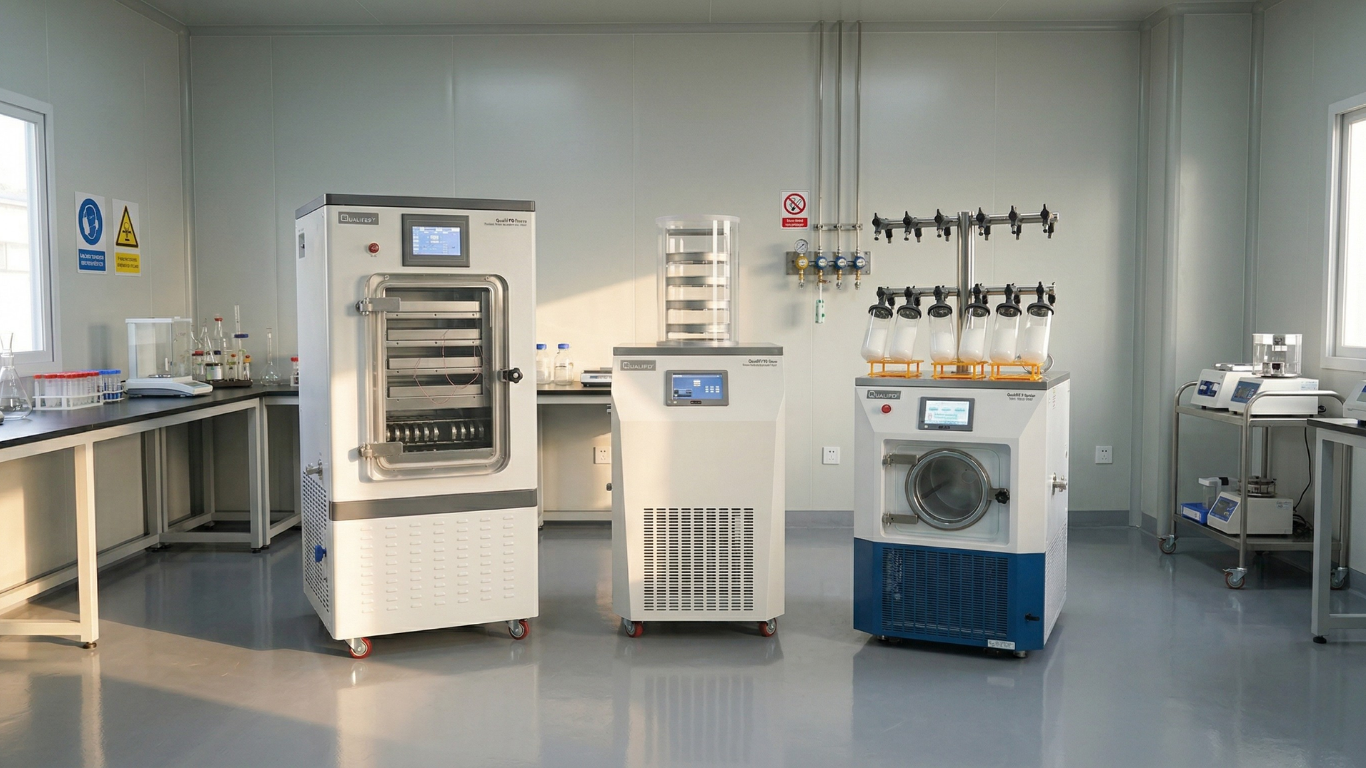
A Freeze Dryer is a sophisticated vacuum system used for lyophilization, a process where moisture is removed from a product through freezing and subsequent sublimation of ice under a vacuum. Unlike traditional heat-drying methods that can damage sensitive structures, lyophilization preserves the physical integrity, chemical purity, and long-term shelf life of biological, pharmaceutical, and food products.
Selecting the right system is a multi-layered decision. It is not just about the size of the vacuum chamber; it is about matching the equipment to your specific batch requirements, product sensitivity, and operational scale. Whether you are conducting fundamental research in a university lab or scaling up production for a global food brand, the right configuration is essential for repeatable success. Before moving into technical specifications, it is often helpful to view the variety of Freeze Dryer options on WorldofTest to understand the current market standards for lab and industrial systems.
What a Freeze Dryer Actually Does
At its core, a Freeze Dryer operates on the principle of sublimation—the direct transition of water from a solid (ice) to a gas (vapor) without passing through the liquid phase. This is achieved by lowering the temperature of the product until it is completely frozen and then applying a deep vacuum.
By bypassing the liquid phase, the material avoids the structural stresses associated with traditional evaporation. This is why lyophilization is the gold standard for preserving sensitive materials like vaccines, antibodies, and high-value food items. The process ensures that once the product is rehydrated, it retains its original properties, flavor, and bioactivity.
Using high-quality Freeze Dryers allows for uniform moisture removal across an entire batch, ensuring that every vial or tray meets the same rigorous quality standards.
Start With the Application, Not the Machine Size
One of the most common mistakes in the buying process is choosing a machine based solely on its physical footprint or price tag. Instead, successful buyers start with their application. Different industries have vastly different requirements for temperature control, vacuum depth, and documentation.
- Laboratory and Research: In microbiology, forensic work, and environmental science, the focus is on sample preservation and method development. These labs need flexibility to handle varying sample types in small volumes.
- Pharmaceutical and Biotech: This sector requires the highest level of precision. When drying vaccines, proteins, or hormones, the system must offer exact shelf temperature control and often requires specialized validation for regulatory compliance.
- Food Processing: For fruits, vegetables, dairy, and meat, the primary goals are nutrient retention and shelf stability. Here, throughput and energy efficiency become the dominant factors.
- Materials Science: In chemical engineering, Freeze Dryers are used for solvent removal and the creation of porous nanomaterials or ceramics, requiring systems that can handle potentially corrosive or specialized chemical environments.
By identifying which of these groups your lab falls into, you can determine if you need a compact lab unit, a specialized R&D Freeze Dryer, or a production-scale Food Freeze Dryer.
Lab Freeze Dryer vs. Industrial Freeze Dryer: The Practical Difference
The transition from lab-scale research to industrial production is a significant jump in both complexity and cost. Understanding where your workflow sits on this spectrum is critical for a wise investment.
Choose a lab-oriented Freeze Dryer when:
- You are working with small, varied batches of samples.
- Your primary goal is research, method development, or small-scale preservation.
- You require a system that is easy to move or fits on a standard laboratory benchtop.
- Your workflow changes frequently, requiring the machine to be cleaned and reset for different product types daily.
Choose an industrial or larger-capacity Freeze Dryer when:
- You have a high-volume, repeatable production requirement.
- You are processing food, pharmaceuticals, or bulk chemicals for commercial distribution.
- You need pilot-scale capabilities to prove a process before moving to full manufacturing.
- Process consistency is non-negotiable, requiring automated cycles that run exactly the same way every time to ensure batch-to-batch uniformity.
The range of available equipment on the market covers everything from cost-effective lab models to high-output, industrial-scale food systems designed for 24/7 operation.
Choosing by Product Type: Food, Pharma, R&D, or Materials
Different materials react differently to vacuum and cold. Your “product” dictates the features your system must have.
Food Freeze Dryer
A Food Freeze Dryer is specifically engineered for the preservation of nutrients, flavor, and texture. These systems are used for everything from instant coffee and powdered milk to ready-to-eat meals and fruits for long-term storage. Because food processing involves large volumes, these machines prioritize tray area and efficient condenser defrosting cycles to maximize daily output.
R&D Freeze Dryer
An R&D Freeze Dryer serves as the bridge between the lab and production. These are essential for formulation work and method optimization in biotech and pharmaceutical sectors. They often feature advanced sensors to monitor the “primary drying” phase, allowing scientists to determine the exact point when sublimation is complete without damaging heat-sensitive biologics.
Large Capacity Freeze Dryer
When a process moves into the manufacturing phase, a Large Capacity Freeze Dryer is required. These systems are designed for bulk processing or large numbers of pharmaceutical vials. They feature robust vacuum systems and high-capacity condensers capable of trapping liters of ice over a single cycle. Consistency and reliability are the hallmarks of these production-oriented machines.
Buyer Checklist: What to Define Before You Request Quotes
Use this decision framework to narrow down your search before engaging with vendors:
- Product Nature: Is it a biological sample, a pharmaceutical drug, a food item, or a synthetic material?
- Batch Size: How much total weight or volume do you need to process per cycle?
- Operating Environment: Is this for a cleanroom lab, an R&D pilot plant, or a food processing facility?
- Thermal Sensitivity: What is the “collapse temperature” of your product? (This dictates how cold your shelves must be).
- Scaling Needs: Do you plan to scale up from R&D to full production in the next 12–24 months?
- Compliance: Do you require 21 CFR Part 11 compliance or other specific data-logging features for auditing?
- Facility Constraints: Do you have the necessary power, cooling water, and floor space for a large system?
- Throughput Goals: How many cycles per week do you expect to run?
Key Benefits Buyers Should Actually Care About
Beyond the basic mechanics, a well-chosen system provides several long-term benefits for your organization:
- Preservation of Purity and Structure: High-quality lyophilization ensures that the crystalline or molecular structure of your product remains unchanged, which is vital for pharmaceutical efficacy.
- Uniform Moisture Removal: Advanced shelf-heating systems ensure that the product at the center of the tray dries at the same rate as the product at the edges.
- Operational Stability: Choosing a system that matches your workload reduces the risk of product degradation due to equipment failure or “melt-back” during the drying process.
- Market Versatility: Having a reliable system allows a lab to move across critical research and industrial production workflows with confidence.
Common Buying Mistakes
- Buying Based on Price Alone: Choosing a budget system that cannot reach the required vacuum depth or temperature will result in spoiled batches and lost R&D time.
- Underestimating Condenser Capacity: If your product has more moisture than your condenser can trap, the vacuum will fail before the cycle ends.
- Ignoring Software Complexity: In an industrial setting, software that is too difficult to program leads to operator errors and inconsistent batches.
- Focusing on Lab Scale Only: If you know you will eventually need a Large Capacity Freeze Dryer, ensure your R&D unit uses the same control logic to make the transition easier.
Industries That Commonly Need Freeze Dryers
The versatility of modern lyophilization systems means they are found in a diverse range of sectors:
- Pharmaceutical and Biotech Companies: For vaccines, biologics, and shelf-stable medicines.
- Food Processing and Agriculture: For high-value snacks, emergency rations, and nutrient-dense powders.
- Chemical and Material Science Groups: For nanomaterial synthesis and solvent extraction.
- Environmental and Forensic Labs: For the preservation of soil, water, and biological evidence samples.
Why Buyers Use WorldofTest to Compare Freeze Dryers
Navigating the transition from small lab units to large industrial configurations requires a platform that understands both ends of the spectrum. WorldofTest presents a wide array of systems, including lab, R&D, production, and industrial-scale food applications. By positioning the category around precision and reliability, they provide a neutral ground for buyers to evaluate different configurations based on their specific industry needs.
Explore Freeze Dryers on WorldofTest and request a quote for the lab, R&D, food, or large-capacity system that fits your workflow.
Final Thought
Choosing the right Freeze Dryer is a strategic decision that impacts the quality of your research or the profitability of your production line. By defining your product type, batch size, and scaling requirements early in the process, you can avoid common pitfalls and select a system that provides long-term value. Whether your goal is the delicate preservation of a new vaccine or the efficient production of shelf-stable food, the right combination of vacuum, temperature control, and capacity is the key to success.
 Wild Rise
  Brendly French