

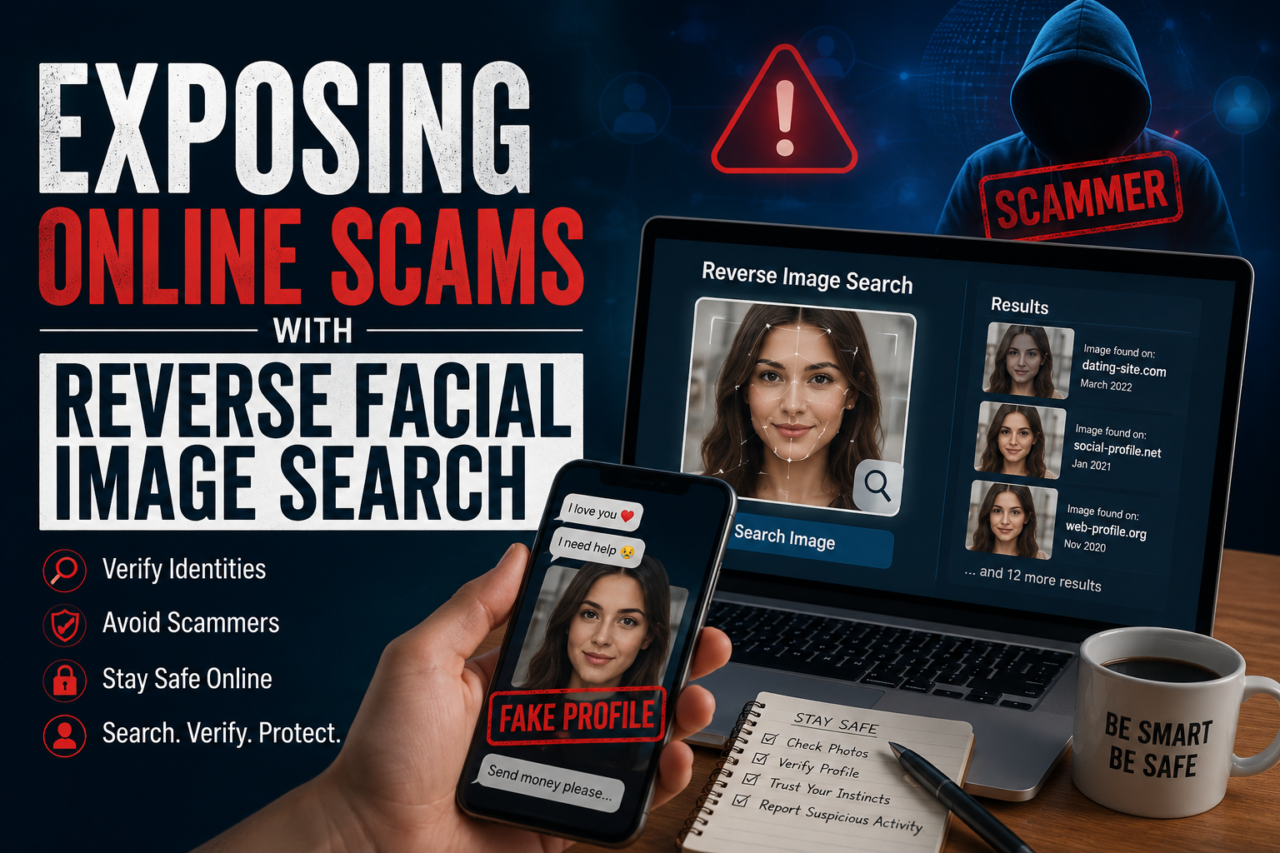
Face matching makes life easier for those looking to catch a scammer by comparing a photo to public databases. Tools comb through indexed images for search results on social media and dating sites. Photo quality, lighting and database size all affect accuracy, making this a critical initial step in validating digital identity.
Scammers do not rob money in the beginning. They steal identities. It is the scourge of slum dog millionaires who had their photos hijacked to create false profiles on dating apps or professional networks, inflicting serious financial and emotional losses. Identifying these bad actors requires precise verification tools. FaceCheck ID uses reverse facial recognition; uploaded faces are mapped to an image database, with rapid recognition accuracy that depends strongly on the quality of the photo taken. People are exposed by merely relying on basic text searches. State-of-the-art facial recognition invisibly reveals these false identities before they can embed.
What Are Reverse Image Searches for Faces?
Conventional search engines find text for a given sample of text. As it turns out, reverse image searches match pixels to pixels.
How does reverse facial recognition work?
A facial search engine checks the geometric measurements of a face. It measures the distance between the eyes, the jawline shape, and the eye socket depth. These measurements form a unique numerical template. It compares this template against millions of publicly available indexed images, searching for identical or near-identical matches.
What limits the accuracy of facial recognition?
Facial search tools do not produce perfect results every time. Several factors disrupt the matching process:
- Low resolution: Pixelated images prevent accurate geometric mapping.
- Poor lighting: Heavy shadows obscure critical facial landmarks.
- Image manipulation: Filters and heavy editing alter the original facial structure.
How Can Users Execute a Reverse Image Search on a Face?
Various commonly available scanning tools will be utilised for generic human features rather than just facial search.
Which verification tools provide the best results?
We need to understand that generic search engines can find a product or a place but rarely recognise a face. Stand-alone facial recognition platforms compile information specifically from publicly available social media profiles, as well as from news articles and blogs.
Step 1: Uploading the suspect image securely
Pull and save the suspect image to a secure device. You should crop the picture so that the face is as large as possible within the frame; also eliminate myriad backgrounds and people. Pass this cropped image to the selected verifier engine.
Step 2: Analysing results and interpreting match data
An engine gives a match and polls, such as confidence. A confidence score of 90% indicates the biometric must match. Users must be proactive and check the source links to see whether the photo appears to come from the portfolio of an actual pro or from someone who has made up an identity.
Which Real-World Scams Does Reverse Image Search Prevent?
We have bad actors who abuse this trust across various digital touchpoints. The earlier you notice the trick, the less loss of money.
Dating app scams and catfishers
Romance scammers steal pictures of good-looking people to entice victims into phoney romances. As a fast facial search can tell you, this photo is often associated with an influencer or stock image library.
Social media impersonation
Scammers are impersonating an account and messaging only the original user’s friends to ask for money. A tool like a TikTok story viewer can even check a suspect account and see how video activity has been recently, but it cannot verify whether anyone claiming to be the account holder is actually them. Testing the profile pic with a facial search engine will verify if the photo posted online shows under several other names.
Online marketplace fraud
Sellers for fake use stolen images to create profiles that look reputable on local marketplaces. Even if a buyer checks the seller’s profile picture, they frequently find it is from another country, which makes the listing fake.
Why is Due Diligence Critical for Digital Security?
Verification goes beyond one image search. Users need to examine others’ digital footprints while defending their own.
Data Statistics: The Financial Impact of Online Scams
The perpetrators even suffer huge financial losses due to identity theft and impersonation. The Federal Trade Commission (FTC) attributes hundreds of millions in losses directly to online fraud.
| Scam Category | Year | Reported Financial Losses |
| Romance Scams | 2021 | $547 Million |
| Investment Fraud | 2022 | $3.3 Billion |
| Impersonator Scams | 2023 | $1.1 Billion |
Protecting digital footprints beyond image search
Reverse image searches can reveal current scams, but proactive measures to make sure that new. Users are required to limit social media privacy settings, keep profile pictures from being publicly indexed and remove their images found on the internet.
Defeating Online Fraud with Digital Literacy
Blind trust is a liability. Criminals exploit the target’s reluctance to confirm simple information. Conducting a reverse image search undermines the scammer’s main benefit, as it reveals fake users right away. Cross-check profile pictures, double-check matching details, and safeguard personal data in order to stroll safely through the online jungle.
FAQs
Is it legal to reverse image search a face?
Yes. Reverse image search engines only scan publicly visible photographs that are indexed on the open web. They do not search hidden databases, private social media accounts and government access only files.
Are facial search tools free to use?
Most platforms will allow you to do a basic search for free. The comprehensive ones that scan deeper social media indexes typically offer subscription-based options or a credit system to view the actual source URLs.
What is the best alternative to facial recognition engines?
In the event that a facial search fails, users should make use of classic reverse-image tools like Google Lens or TinEye. These engines search for exact image copies, not match them biometrically, which is how they help identify stolen stock photos.
How long does a reverse face search take?
Most facial recognition engines deliver results in 30 seconds to 2 minutes, depending on server load and the size of the image database being queried.
Can someone tell if I reverse searched their photo?
No. When an image is uploaded to a search engine, it does not trigger any notification of the original owner. The process is completely anonymous.
 Oscar James S