

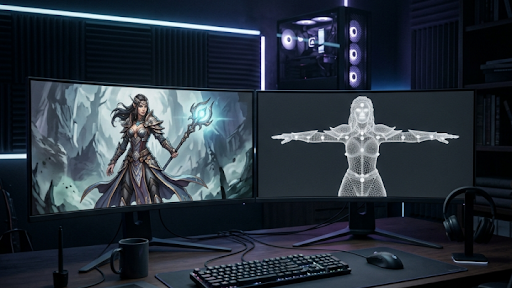
Game development requires close collaboration between concept artists and 3D modelers. Traditionally, converting 2D designs into physical models creates communication delays that slow down production schedules. To bridge this structural division, Neural4D, an advanced digital platform jointly developed by Nanjing University, DreamTech, the University of Oxford, and Fudan University, has created an online 3D model creator designed to automate asset conversion.
The platform allows designers to generate 2D reference images and convert them into three-dimensional models. These generated 2D images can be inputted directly into Neural4D and its Image to 3D function to reconstruct high-precision 3D models, establishing a direct 2D-to-3D creative workflow. This pipeline allows teams to build draft assets in minutes.
Breaking the Barrier Between Design Stages
In standard game pipelines, a concept artist draws a character or object, which is then handed to a modeler who manually shapes the polygons. This manual interpretation often alters the original design. Utilizing the automated conversion processes in Neural4D-2.5 ensures that the final model matches the reference drawing by analyzing details directly from the source image.
- Direct reconstruction of shape proportions and contours.
- Automatic alignment of surface coordinates.
- Fast generation of baseline assets for rapid visualization.
Generating Physics-Based Textures from Art
A major challenge in asset production is creating high-quality maps that interact correctly with lighting engines. The Direct3D-S2 engine inside Neural4D-2.5 separates the color values of the concept art from the ambient shadow patterns, generating clean PBR maps.
- Automated separation of metallic and roughness maps.
- Clean normal map calculation to simulate depth details.
- Smooth texturing that adapts to custom environment settings.
Integration with Modern Production Environments
To maintain efficiency, the generated assets must be compatible with standard game engines. The meshes export directly into standard digital formats without requiring complex conversion tools.
- Direct import capabilities for Unreal Engine and Unity projects.
- Export files optimized in GLB and FBX formats.
- Efficient polygon layout to prevent runtime performance degradation.
 Munjal Blog